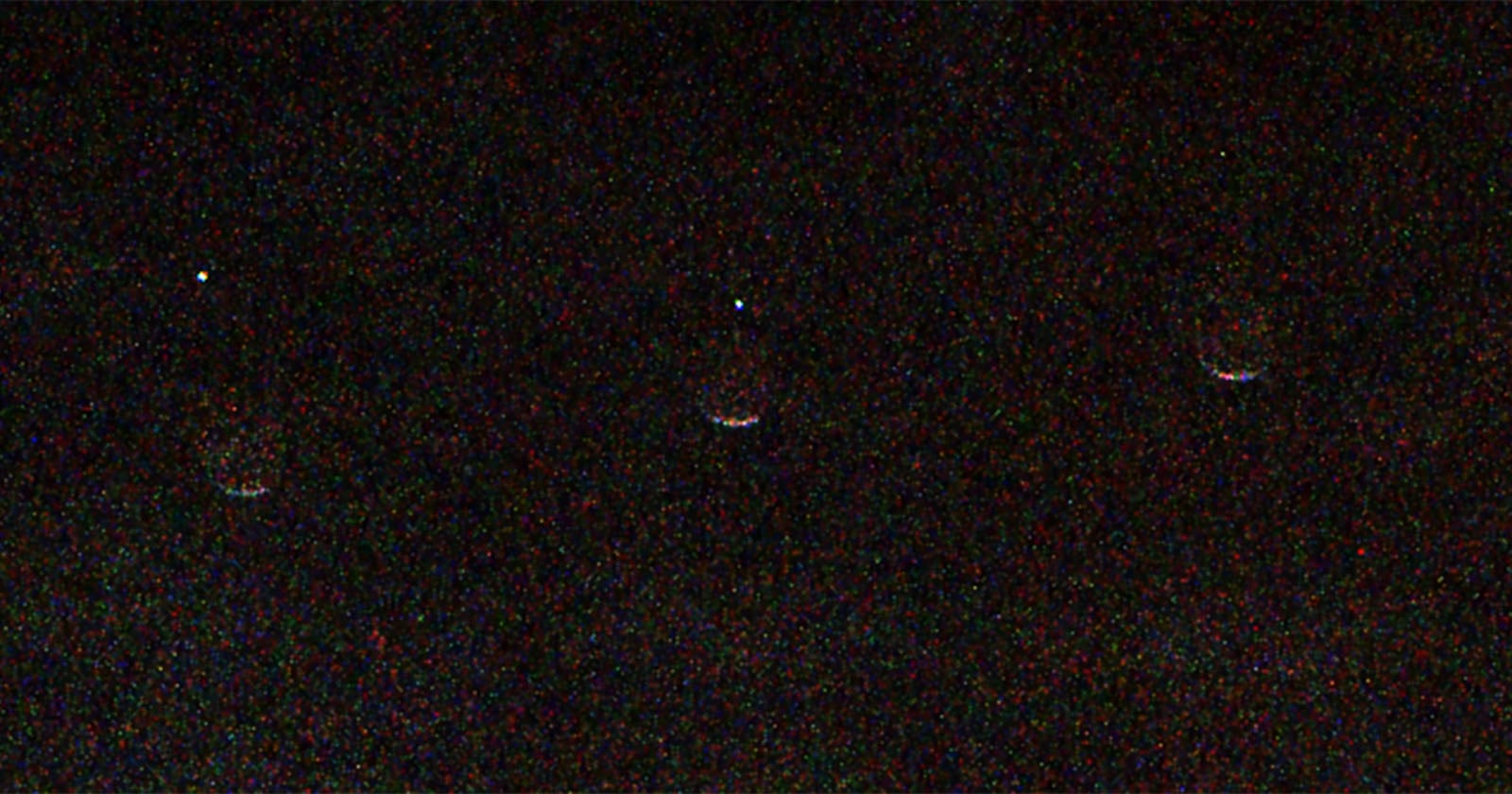
There is a peculiar intimacy in a grainy image, and NASA's latest postcard from the Perseverance rover is nothing if not that. Captured with the Mastcam-Z instrument, the photograph shows Earth as a distant, bright point of light drifting behind Phobos, a tiny Martian moon that looks less like a celestial body and more like a celestial potato. On its own, the image is a study in contrast: three brilliant white specks against a void, each trailing a faint, colorful arc of atmospheric diffraction. It is not a high-resolution masterpiece, and that is precisely the point. This is a raw, authentic glimpse across 140 million miles of space, a reminder that some of the most profound art is not staged, but simply observed.
We spend so much time curating our own visual worlds, from the glossy frames of a Leica Lux 2.0 update to the deliberate shadows of a Nikon’s black and white study. Those tools are about control, about bending light to serve a specific aesthetic vision. This Martian photograph is the opposite. It is a happy accident of optics and timing, a moment where the mechanics of a rover's eye just happened to line up with the geometry of our solar system. Yet, it holds a similar artistic weight. It strips away the artifice, leaving us with the raw, unvarnished reality of our place in the universe. Just as a photographer might chase the perfect imperfect moment on a city street, Perseverance found one in the dark, simply by looking up at the right time.
For our readers, who appreciate both the form and the function of a well-told story, this image is a masterclass in perspective. It is easy to get lost in the vibrant energy of a fashion week showcase or the latest lens that promises to transform our mobile photography. We chase these things because they feel immediate and important. But this distant glimpse of home, a pale blue dot hiding behind a lumpy rock, recalibrates the scale. It is not a warning or a grand philosophical statement; it is simply a fact. We are here, and we are small. The practical takeaway is not about the science, though that is fascinating. It is about the quiet humility that comes from seeing your whole world reduced to a single pixel of light. That is a perspective no wide-angle lens can give you, and it is one we should all carry with us into our next creative project.
What we would tell a friend who asks about this image is simple: do not dismiss it for its lack of clarity. The grain is the story. It represents the immense distance, the technical challenge, and the sheer audacity of a machine on another planet sending a message home. It is a reminder that the most powerful images are not always the sharpest or the most color-graded. Sometimes, they are just the most honest. The question we are left with is not what we see, but what we choose to do with that perspective. Can we hold onto that feeling of smallness and turn it into work that feels more grounded, more authentic, more human? The next time you pick up your camera or your brush, think of that grainy dot. Let it be the creative constraint that frees you.