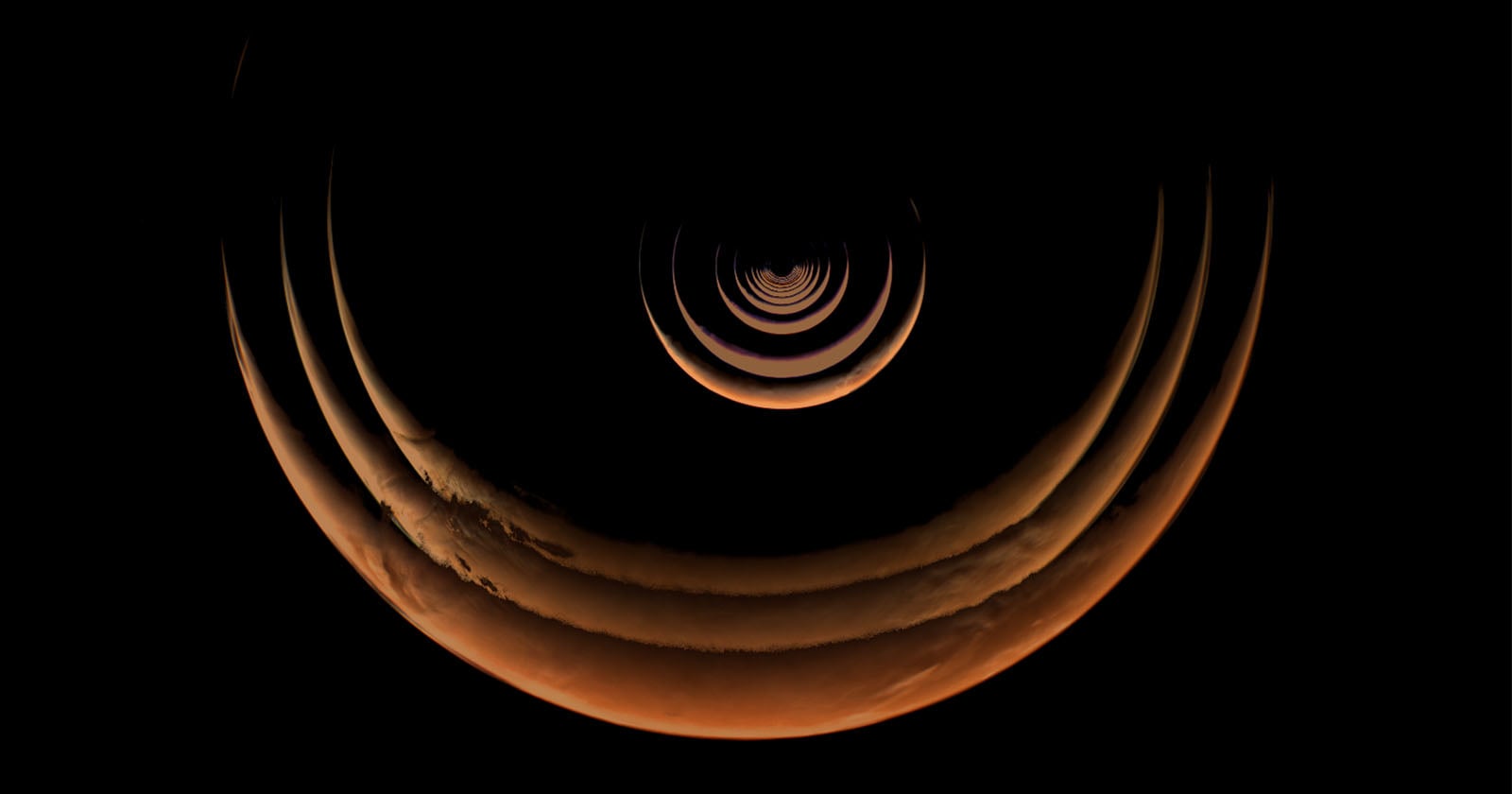
There is something quietly profound about watching a spacecraft turn a planet into a series of crescents. NASA's Psyche mission spent most of May approaching Mars, slipping within 2,864 miles of its surface, and the resulting timelapse is less a scientific record and more a kind of cosmic choreography. The images, released by the Jet Propulsion Laboratory, show the Red Planet growing from a distant point of light into a massive, curved presence, then shrinking back into the dark. It is a visual rhythm that feels almost intentional, like a slow exhale across 900,000 miles of space. We are used to seeing Mars as a static icon, a red dot in the sky or a dusty landscape in a rover's selfie. Here, it is a body in motion, and that motion changes how we see it.
For our readers, especially those who spend their days chasing light and composition, this timelapse is a masterclass in patience and perspective. It reminds us that the best images are rarely about the subject alone, but about the relationship between the observer and the observed. Psyche's camera did not just document Mars; it interpreted it, revealing phases and shadows that we rarely pause to consider. This is not unlike the work of street photographers who wait for the right moment to align a shadow with a stranger's step, or the archival impulse that drives us to revisit older gear, as we did with the The Curated Archive: Revisiting the Olympus E-M5, the Original Icon. There, the subject was a camera that changed how we thought about portability and image quality. Here, the subject is a planet, but the lesson is the same: the frame matters, and so does the wait.
What strikes us most is the deliberate pacing of the whole endeavor. Psyche did not rush past Mars. It approached, lingered, and then drifted away over the course of weeks. That kind of patience is rare in our own world of instant uploads and fleeting stories. It is a good reminder that some of the most compelling visual work comes from committing to a single point of view for a long time. We see this in the quiet, considered frames of street photography, like those in Moments Captured: Shin Noguchi’s Street Photography, Now in a Deck, where a single frame can hold a whole narrative if you are willing to wait for it. Psyche's timelapse is that same idea stretched across millions of miles, a reminder that the camera does not just capture a moment; it can also capture a relationship.
If we were to give you one takeaway, it would be this: the next time you are waiting for the light to change, or for a subject to move into place, remember that even a spacecraft aimed at a distant asteroid knows the value of a long, slow approach. The practical lesson for photographers and creators is to embrace the in-between moments, the approach and the departure, not just the climax. The most honest answer we can give to anyone asking what this means for them is simple: slow down, keep your camera ready, and let the subject come to you. The final frame of Psyche's timelapse, with Mars reduced to a thin silver sliver against the black, is not an ending. It is a question about what we choose to look at, and for how long.