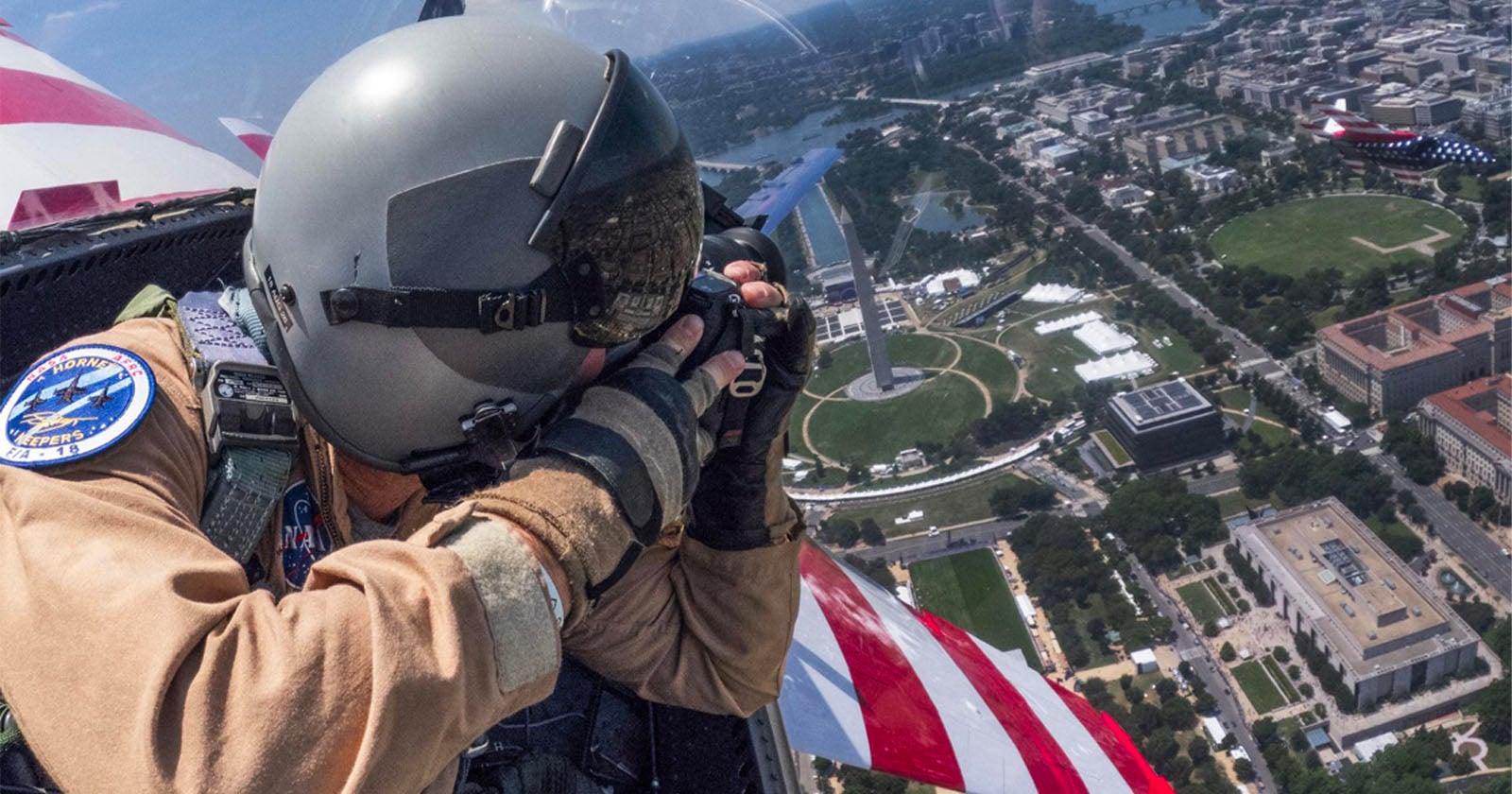
There is a particular kind of silence that comes with seeing your city from above, a stillness that transforms familiar landmarks into abstract geometry. NASA photographer Jim Ross experienced that silence differently last week, strapped into the back seat of an F-18 as it screamed over Washington, D.C. on America's 250th birthday. His assignment was not scientific data collection or military reconnaissance. It was something rarer: the act of making art from altitude, capturing the capital's spirit through a lens while traveling at speeds most of us will never feel. For a brand that lives at the intersection of creativity and vitality, this is more than a cool news item. It is a quiet manifesto about how we choose to see the world.
We often talk about fitness as a discipline of the body, but moments like this remind us that discipline is equally about vision. Ross did not simply point a camera out of a cockpit window. He spent years building the trust and technical precision required to sit in an F-18, to anticipate the light, to hold steady against G-forces that would blur a lesser eye. That is the same muscle we ask our readers to develop in their own lives: the ability to commit to a craft so fully that the extraordinary becomes routine. Whether you are refining a yoga flow or curating a capsule wardrobe, the principle holds. Excellence is not accidental. It is the result of showing up, over and over, until the difficult becomes instinctive. Ross's flight over the National Mall is a literal elevation of that idea, a photographer rising above the grid to frame what we already know, but from a perspective that makes it feel new.
For the creative collaborators and health-conscious enthusiasts who follow our work, the practical takeaway here is direct. Inspiration does not always arrive in a studio or a gym. Sometimes it comes from borrowing the tools of another discipline, in this case, a fighter jet and a NASA assignment, and applying them to your own vision. You do not need an F-18 to change your vantage point. You need the willingness to ask: *What would happen if I looked at this from somewhere I have never stood?* That question is the same one that drives an artist to try a new medium, or an athlete to train in an unfamiliar environment. Ross's images from that cockpit are not just photographs of Washington. They are evidence that the most compelling work often emerges from the collision of two worlds that rarely meet, high-speed aviation and patient, deliberate observation.
What we would tell a reader who asked us about this story is simple: pay attention to the frame, not just the subject. Ross could have shot the same monuments from a helicopter or a drone. He chose the F-18 because it forced a constraint, speed, noise, vibration, limited time, that demanded total presence. That constraint is the hidden ingredient in almost every piece of work that moves us. It is the reason a hand-drawn sketch feels more alive than a perfect digital render, or why a live performance holds a different energy than a recorded track. So the next time you feel stuck in your own practice, ask yourself what limitation you could embrace. Maybe it is a shorter deadline, a smaller space, or a tool you have never used. Jim Ross strapped himself into a fighter jet to find his answer. The question is worth borrowing, even if your cockpit is just a corner of your own city, waiting to be seen from a new angle.