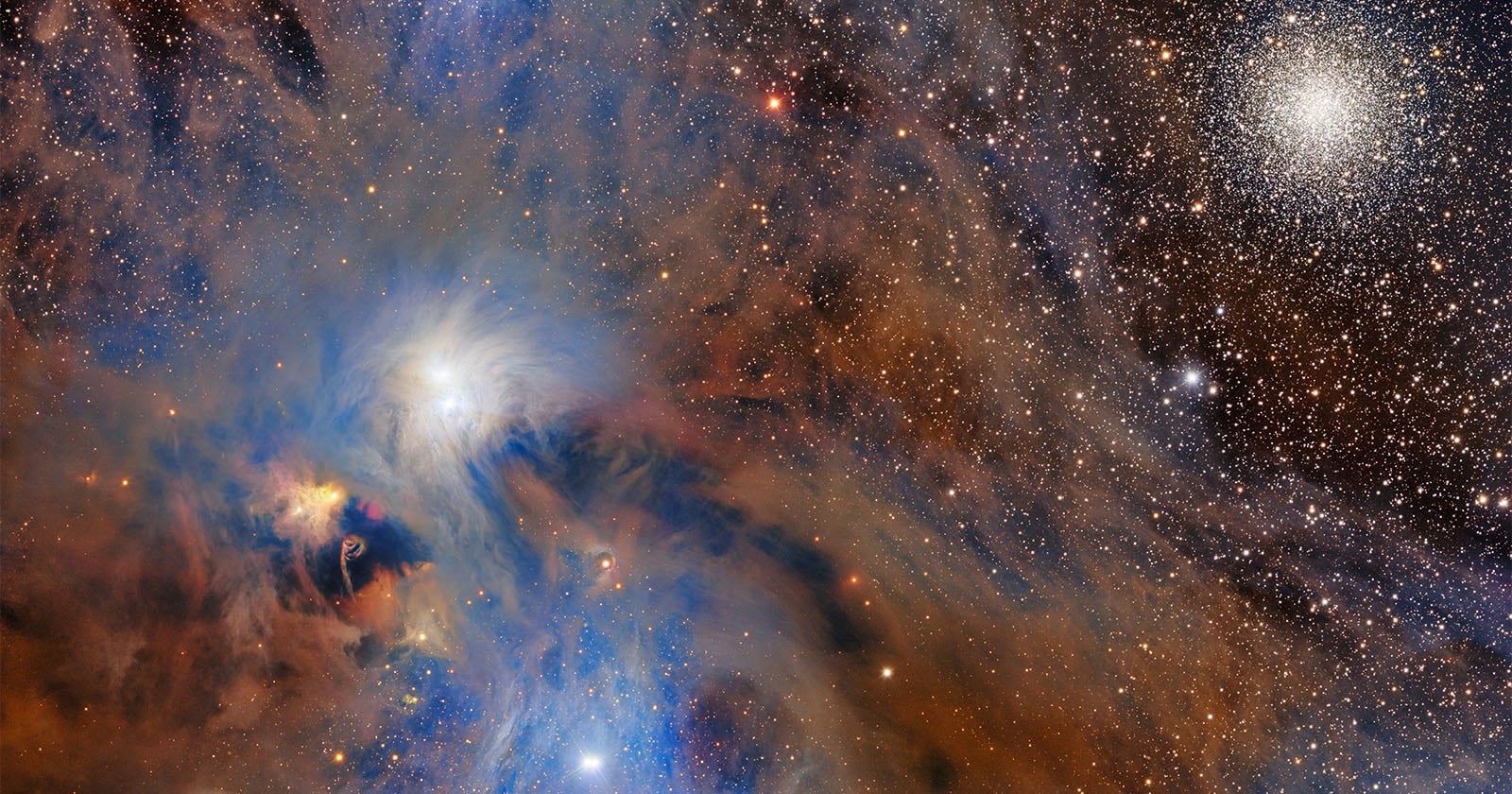
There is a photograph making the rounds that looks as though Vincent van Gogh climbed into an observatory and painted the sky from inside the telescope. The Dark Energy Camera (DECam), a 570-megapixel instrument housed in the Victor M. Blanco 4-meter Telescope, has turned its gaze toward the Corona Australis Molecular Cloud, one of the closest star-forming regions to Earth. The result is a swirl of blue, orange, and brown clouds, dense clusters of bright stars, and a composition that feels less like raw data and more like an intentional brushstroke. It is a reminder that science, at its most compelling, does not merely document the universe; it interprets it.
We have written before about how photography can stretch our sense of what is possible. In Capturing Cosmic Beauty: An Astrophotography Journey with Nikon, we explored how human photographers chase the same celestial subjects with consumer gear, often waiting hours for a single frame. DECam's image is different. It was built to map dark energy, not to hang in a gallery. Yet here it is, producing an image that rivals any fine-art astrophotograph. The irony is worth sitting with: a camera designed for cold, statistical measurement of cosmic expansion has delivered something that feels deeply emotional. And in Unlock New Perspectives: AI-Powered Telescope Transforms Smartphone Bird Photography, we saw how technology can reframe an everyday subject like a bird into something extraordinary. DECam does the same for a nebula, except the nebula is 500 light-years away, and the camera is the size of a compact car.
What strikes us most is the collision of intention and accident. The astronomers who operate DECam did not set out to make art. They set out to measure the expansion rate of the universe. But when you point a 570-megapixel sensor at a star-forming cloud, you cannot help but capture something that looks like a painting. The swirling blues and oranges are not artistic filters; they are the real emissions of ionized gas and scattered starlight. The dense cluster of bright stars in the upper right corner is not a flourish; it is a nursery of young suns. This is the universe doing what it does, and the camera simply holding still long enough to let us see it.
Our take is this: the boundary between science and art is not a line, it is a lens. If a reader asked us what to make of this image, we would tell them to stop looking for the divide. The same curiosity that drives a poet to describe a sunset drives an astronomer to calibrate a CCD sensor. The difference is only in the tools. And the takeaway we would quote back to anyone who asks: the most beautiful images of the cosmos are not made by choosing between precision and poetry, they are made when you refuse to choose at all. The question worth watching is what happens next. If a dark-energy camera can produce a van Gogh, what else are our instruments quietly creating without us noticing?