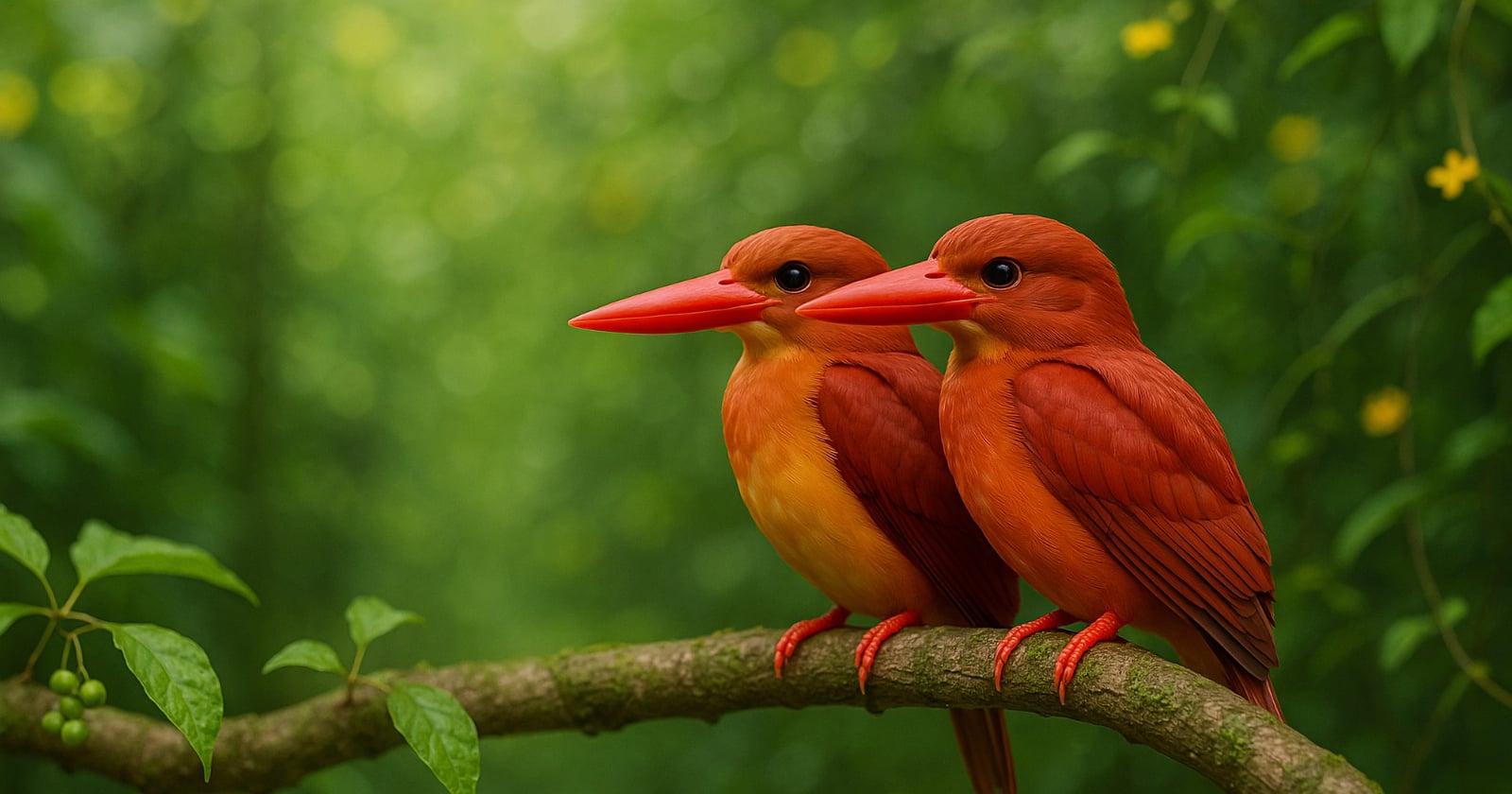
There is a particular kind of magic in a wildlife photograph that stops us mid-scroll, and the image at the heart of this week's story is no exception. Two vivid kingfishers, their plumage impossibly bright, perch against a dreamy, bokeh-filled backdrop. It is a stunning piece of visual art. But as scientists now warn, that beauty may be a fabrication. The increasing use of AI editing tools by photographers chasing the perfect frame is threatening the very foundation of bird research, where a single altered image can skew migration data or habitat assessments. We are big believers in artistry, but when a tool quietly blurs the line between documenting a moment and inventing one, we have to ask what is being lost. This is not about banning a new toy; it is about understanding the weight of a shutter click. It is a conversation that feels particularly urgent when we consider how we document the natural world, a theme that also runs through the A Quiet Count: South Africa's Cheetah Population Reveals a Stark Reality, where the integrity of camera trap data is the only thing standing between a species and obscurity.
For the creative community and the health-conscious enthusiasts we speak to, this is not a dry academic debate. It is about the stories we tell with our images. The same technological impulse that lets us curate our feeds with an artistic eye also tempts us to remove the stray branch or the awkward shadow. But a bird's leg that is too straight, a feather pattern that is too symmetrical, or a background that melts in an unnatural way are not just aesthetic choices. They are data points that, when falsified, ripple outward into conservation policy and scientific literature. We are not suggesting that every photographer who uses a healing brush is a villain. The issue is the silent pivot from photography as a faithful witness to photography as a pure expression of personal taste. We would tell a reader who asks, "Is my editing ruining science?" to consider intent and transparency. If you are submitting to a research archive or a citizen science project, that image is a specimen. If you are creating for an art gallery, it is a painting. The two are not interchangeable, and the confusion between them is where the risk lies.
This is where our own editorial take sharpens. We see a parallel between this story and the Capturing Cosmic Beauty: An Astrophotography Journey with Nikon, where the artist's goal is to translate nebulae and galaxies into something we can feel. There, the image is unapologetically an interpretation of reality, not a record of it. But for a bird guide or a field researcher, the photograph is evidence. The danger is that we are normalizing a visual language where the real and the synthetic are indistinguishable, and in doing so, we lose the ability to trust our own eyes. The practical takeaway here is not to abandon editing, but to adopt a strict code of conduct. Mark your work. If you use AI to remove a distracting element, say so. If you enhance color for emotional impact, disclose it. We would argue that this transparency is not a weakness but a signature of authenticity, a trait we champion in every curated detail of our lifestyle. The Experience Photography's Artistry: The 5 Boro Foto Fest Returns celebrates the craft, and craft includes the honesty of the hand that made it.
The specific consequence to watch is the eventual split between "photography" and "AI-assisted imagery" in scientific repositories. That change will not be driven by a single dramatic scandal but by the slow erosion of trust that happens every time a quiet, perfect kingfisher turns out to be a digital ghost. For our readers, the challenge is to be the discerning eye. When you see a breathtaking bird photo, pause. Ask not just if it is beautiful, but if it is true. That question is not a buzzkill; it is the very thing that keeps our sense of wonder grounded in a world that increasingly wants to float away.