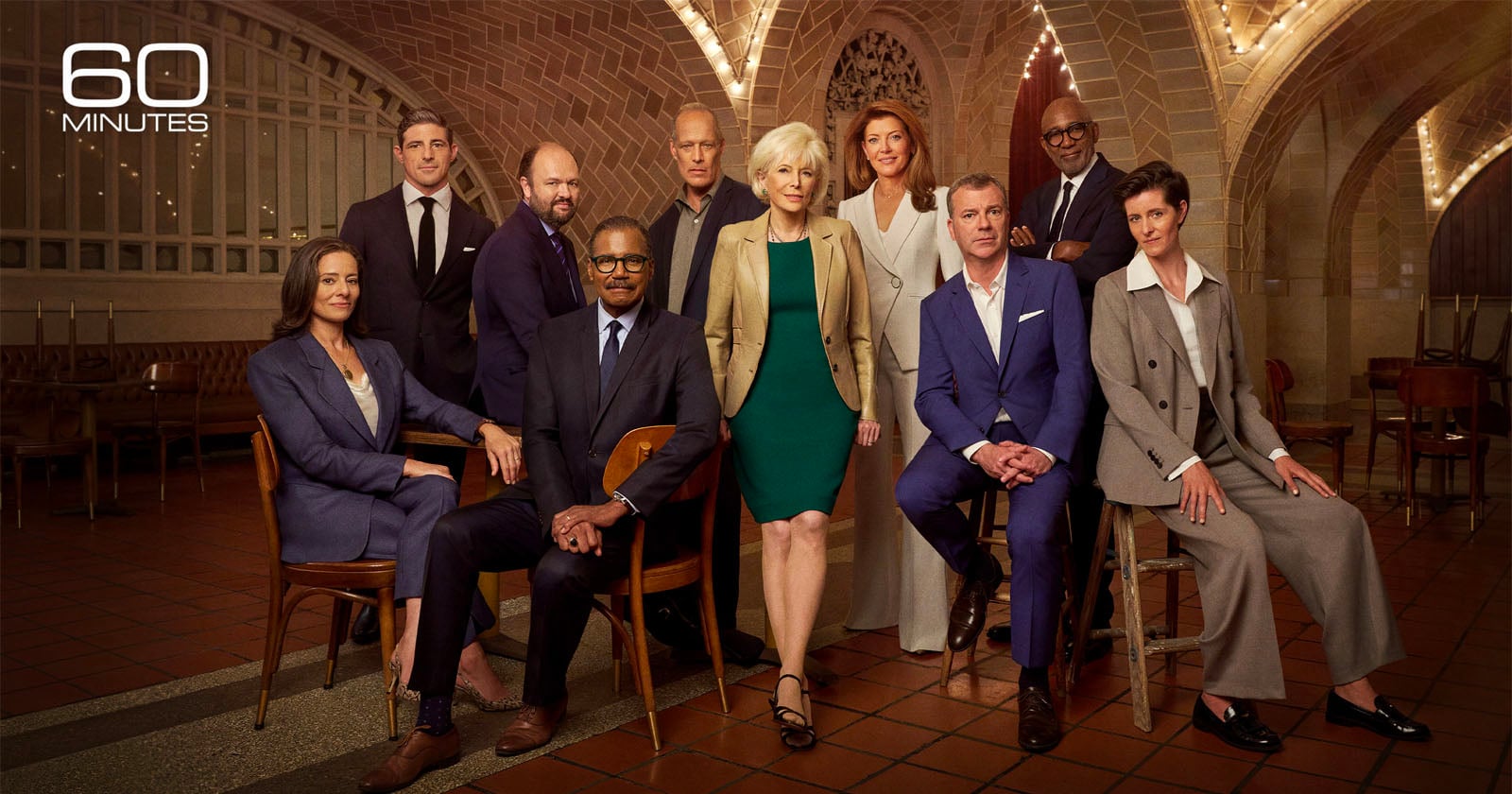
The image in question is a group of ten people, five men and five women, posed in a tiled, arched room with the *60 Minutes* logo. CBS has been forced to deny that the promotional photo for the upcoming series was manipulated. The speed of the denial is telling. In an era where every pixel is subject to forensic scrutiny, a simple portrait becomes a Rorschach test for our collective distrust. We want to believe in the authenticity of what we see, yet we are conditioned to expect the worst. This tension is where the real story lives, not in the lighting or the shadows, but in the reflexive need to question the frame itself.
Our take is that this moment is less about the technicalities of image editing and more about the currency of trust. For our audience, who curates their lives with an artistic eye, this is a familiar dance. You know that a boudoir session or a collaborative photo shoot requires a certain understanding of light and mood, a crafted authenticity that serves the final image. Similarly, when Leica refines its iPhone photography or a full-frame camera is reimagined for accessibility, we are talking about the tools that help us shape perception. The *60 Minutes* photo is a different beast. It is a promise of journalistic integrity, a genre where the line between polish and deception is a matter of public record. When CBS says it is "not manipulated," they are asking us to accept a binary in a world that operates in gradients.
The practical takeaway for you, the discerning creative, is to understand the difference between a curated aesthetic and a deceptive practice. A portrait that uses flattering light is a choice; a portrait that erases a person's essence is a lie. The public's reaction to the *60 Minutes* photo is a reminder that intention matters less than perception. You can spend hours perfecting a composition, but if the viewer feels you have taken a liberty with reality, your credibility suffers. This is why we champion authenticity in our own work, whether we are discussing the raw emotion of a boudoir session or the technical precision of a new camera system.
The question we should all be asking is not whether the photo was altered, but why we are so quick to assume it was. The next time a brand, a publication, or even a colleague presents an image, we should pause. Instead of looking for flaws, we could ask what story the image is trying to tell. The most sophisticated viewers know that a photograph is never the whole truth, but it can be a beautiful version of it. The real issue isn't the manipulation of pixels; it's the manipulation of expectation. Watch how quickly the conversation shifts from the technical to the ethical, and you will see the line we all walk. The detail to watch is not the photo's resolution, but the clarity of the response.