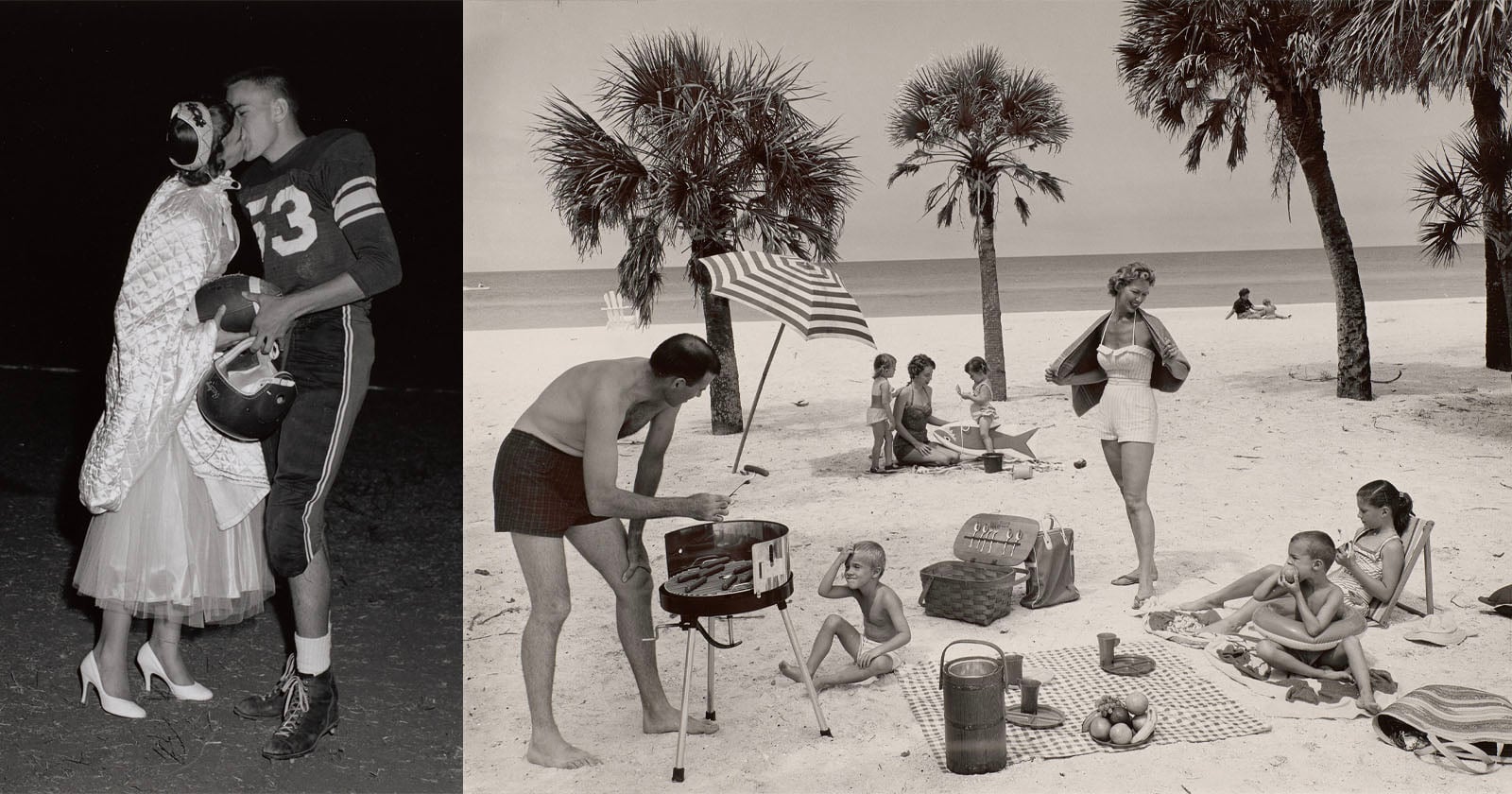
The exhibition's title, *The Way We Never Were*, is the sharpest piece of curation we have seen in a long time. It does not ask us to mourn a lost golden age; it asks us to examine why we believed in it at all. Harvard Art Museums has pulled from its own extensive photographic collection to build a show that treats the camera not as a recorder of truth, but as a co-conspirator in a national fantasy. The images of picket-fenced suburbs, grinning families at beach picnics, and young couples in varsity jackets are not lies, exactly. They are selections. And selections, as any editor knows, are arguments. This is a show about the distance between the frame and the life lived just outside it, and that distance is where the real story lives.
For our readers, this is not an academic exercise in art history. It is a mirror held up to the way we consume lifestyle imagery today, and we should feel the heat. The same machinery that sold postwar America on a singular, airbrushed ideal is alive and well, only now it is algorithmically optimized and served to us in infinite scroll. We scroll past the perfectly lit workout, the curated kitchen, the aspirational travel shot, and we absorb the fiction as a standard. The curators at Harvard are doing something more radical than debunking a myth; they are inviting us to notice our own participation in the performance. If you have ever felt a quiet pang of inadequacy while scrolling, this exhibition is the antidote. It does not tell you to reject beauty or ambition. It tells you to ask who is holding the camera and what they left out of the frame.
Our honest take is that this is the most important kind of photography show precisely because it refuses to stay in the gallery. It reaches into the practical realm of how we build our own self-image. We would tell a reader who asked us about it this: go see it, not to feel smarter than the past, but to become more fluent in the visual language you are swimming in every day. And if you cannot make it to Cambridge, the lesson travels. When you next see a brand campaign that promises a perfect life, or a social post that looks effortless, remember the title. Ask yourself what is being sold, what is being hidden, and why the myth needs defending. The conversation around visual authenticity is not new, but it is urgent, and we have been circling it from other angles: the way photography exposes the fiction of the perfect moment is the same mechanism behind the staged realities of modern influencers and the craft of editorial styling that we so often mistake for candid life.
What we would watch for is the show's quiet insistence on context. The curators are not just hanging prints; they are exposing the editorial process behind the prints, the cropping, the staging, the selection of the negative over the contact sheet. That is where the practical takeaway sharpens to a point: the next time you see a single image that claims to represent a life, a body, or a nation, remember that every frame is a decision to exclude a thousand other truths. The most sophisticated viewer is not the one who sees through the image, but the one who sees the entire process of its making. That is the real art, and it is a skill we all need now more than ever.