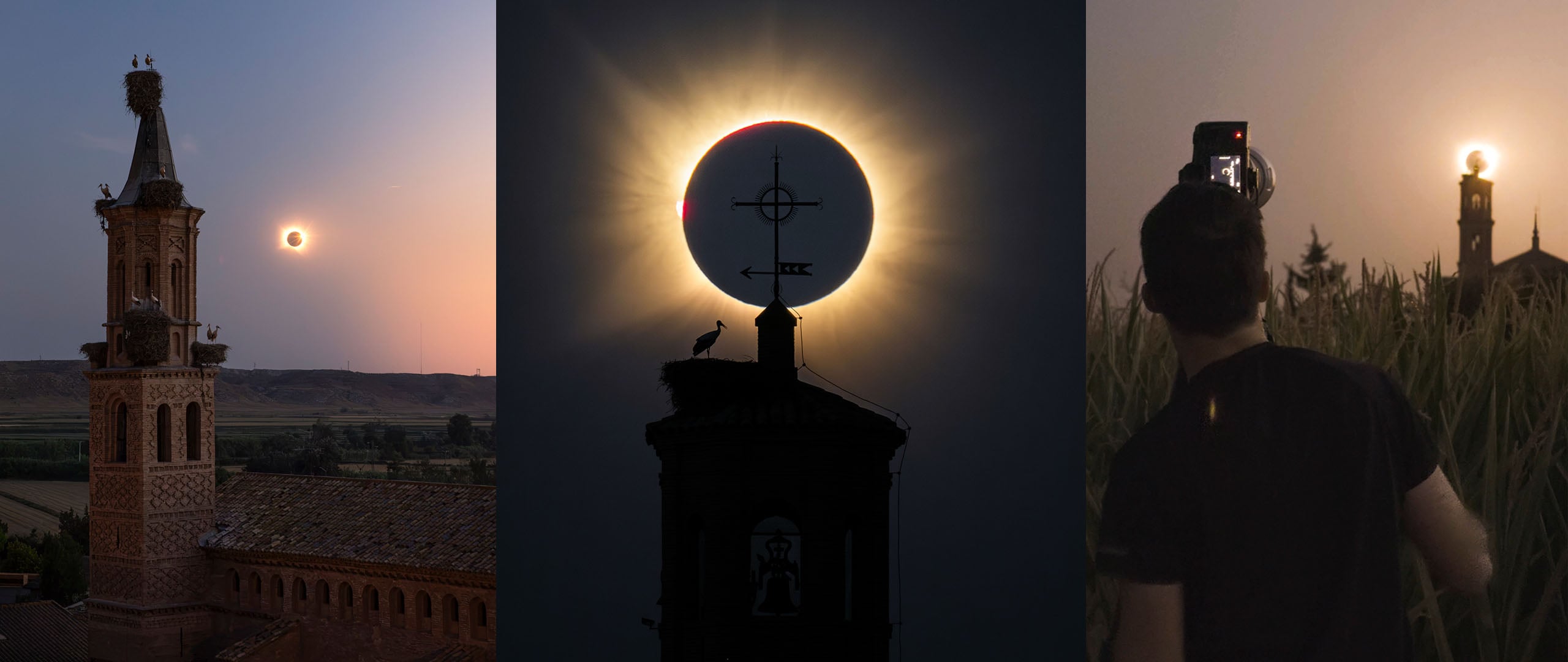
There is a particular kind of obsession that separates a photograph from a trophy. It is not the gear, the location, or even the raw talent, though all of those play their part. It is the willingness to stake an entire year, maybe more, on a single window of thirty seconds. Canadian photographer Liron Gertsman and Texas-based bird photographer Tobias Yoder know this intimately. They traveled to Spain with a shared vision: a total solar eclipse framed not just by the sky, but by the living, breathing architecture of the landscape. The result, as reported in a recent feature, is a triptych of near-perfect alignment, but the path to that perfection was anything but guaranteed. It is a story that feels less like a nature documentary and more like a heist film, where the prize is not gold, but a sliver of darkness in the middle of the day.
For the uninitiated, the urge might be to ask, "Why the pressure?" After all, the sun is predictable, the moon's shadow a matter of orbital mechanics. But the variables that truly matter are the ones you cannot script. The composition had to be precise, with the eclipse positioned perfectly behind a church tower and its resident storks. The light had to behave. The weather had to cooperate. And then, the birds, those wild, unscriptable elements, had to be in the right place at the right time. Gertsman and Yoder did not leave that to chance; they left it to preparation. They scouted, they planned, they studied the geometry of the sky and the ground. Yet, as the article notes, success came down to the wire, a matter of thirty seconds. That is the real takeaway here, and it is one that resonates far beyond the world of astrophotography. It is a masterclass in the tension between control and surrender, a reminder that the most curated moments still require a willingness to let the moment happen.
We often talk about the "decisive moment" in photography, but this story reframes it. It is not just about capturing the action; it is about being the kind of person who positions themselves to be lucky. For our readers, whether you are chasing a rare celestial event or simply trying to elevate your own creative practice, the lesson is not to obsess over the perfect conditions, but to prepare relentlessly for the imperfect ones. You cannot make a stork fly, and you cannot ask the sun to wait. What you can do is know your subject so intimately that when the window opens, you are already there, finger on the shutter. This is the difference between taking a photo and making a photograph. It is the difference between hoping for a moment and being ready to seize it. The article is not just a showcase of beautiful imagery; it is a quiet argument for the power of commitment.
If a reader asked us what to take from this story, we would say this: do not wait for the perfect project. Pick the one that scares you a little, the one that requires you to coordinate a year of your life around a date on a calendar. The storks will not wait, and neither will the light. The practical consequence of this mindset is a shift from being a consumer of inspiration to an active participant in its creation. We are watching two artists who understood that the magic was not in the eclipse itself, but in the choreography of the world around it. The question we are left with, and the one we hope lingers in your mind, is not "How did they do it?" but rather, "What are you willing to wait thirty seconds for?" Because that is the detail that matters. That is the threshold where the ordinary falls away and the extraordinary, however fleeting, finally comes into focus.