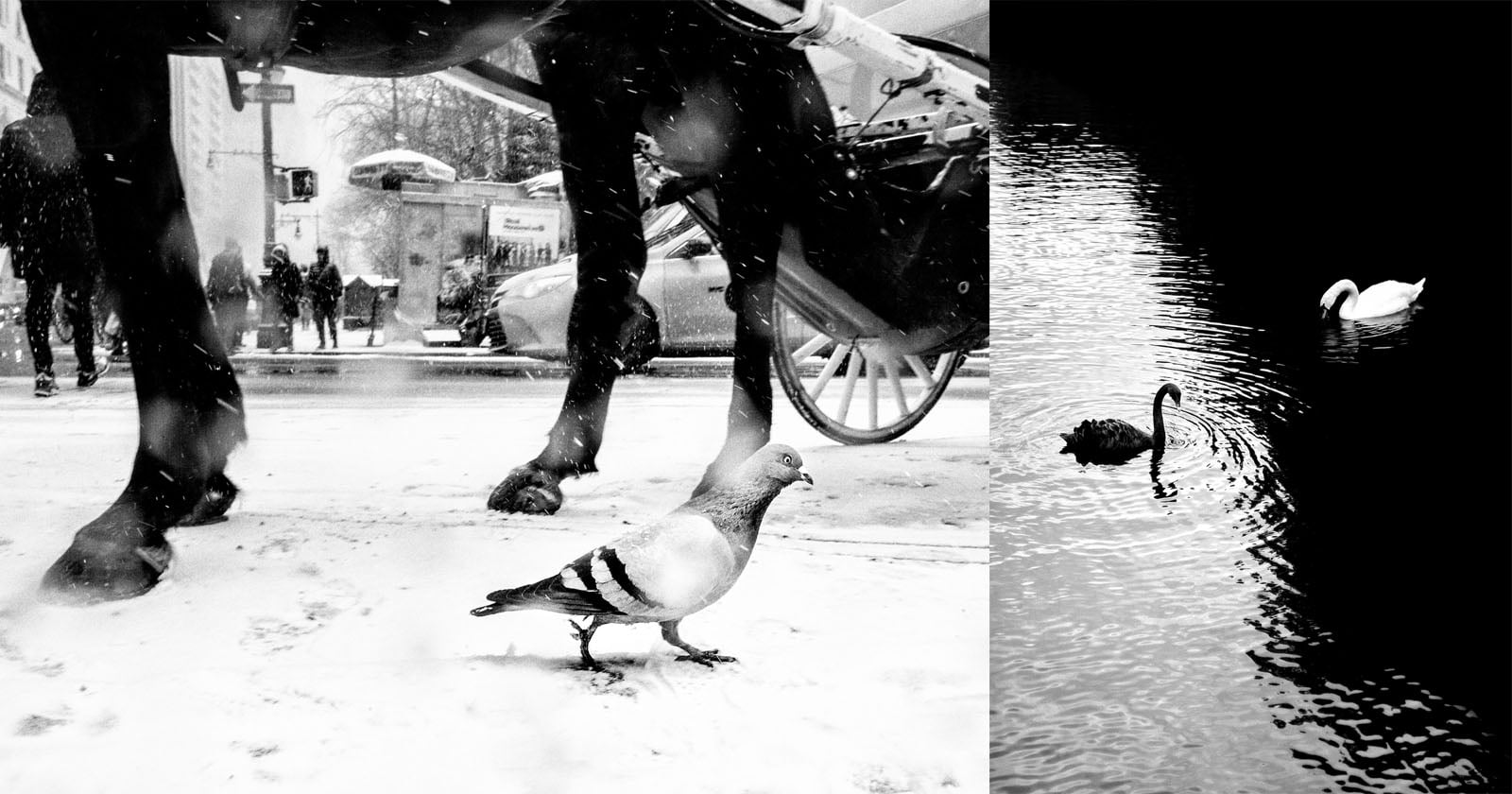
Alan Schaller's first book, *Metropolis*, captured the quiet weight of urban isolation, a somber, necessary meditation on how we drift apart in crowded spaces. His second book, as the excerpt from Finding Connection: Alan Schaller's Portraits of Urban Wildlife suggests, promises something lighter. Where the first volume looked at people alone, this one turns the lens toward animals sharing our streets, parks, and waterways. The shift feels deliberate, and it works. Schaller's black-and-white frames, a pigeon on snowy ground beneath a horse-drawn carriage, a white swan and a black swan gliding through dark water, offer a different kind of city story. It is less about loneliness and more about the quiet, often overlooked connections that thread through daily life. For readers who value authenticity and artistry, this is not a departure from his earlier work but a natural expansion. He is still documenting the urban landscape; he has simply found a new subject through which to explore it.
What this means in practical terms is a chance to rethink how we see our own surroundings. Schaller's photographs remind us that connection does not require grand gestures. It can be a pigeon standing still while commuters rush past, or two swans moving in tandem without a word. For the creative collaborators and health-conscious enthusiasts in our audience, this is a useful perspective. Whether you are curating a feed, designing a space, or simply walking through your neighborhood, the invitation is to notice the moments that feel unscripted. The Street Safari project does not preach. It observes. And that observational quality is exactly what makes it aspirational without feeling pretentious. Schaller is not telling us to be better; he is showing us what is already there, if we bother to look. That is a more durable kind of inspiration, one that fits naturally into a lifestyle that values both form and function.
Our honest take is this: Schaller's second book matters because it resists the easy cynicism of urban photography. Too often, city images default to grit, alienation, or ironic detachment. *Metropolis* did isolation honestly, but this new work chooses a different note. It finds humor and warmth without becoming saccharine. The specific takeaway a reader could quote is this: "Connection is not something you manufacture; it is something you frame." Schaller frames it through animals, but the principle applies anywhere. If a reader asked us whether this book is worth their time, we would say yes, not because it solves anything, but because it offers a way of seeing that is both artistic and grounded. It is a reminder that sophistication does not require complexity; sometimes it is a pigeon in the snow, and that is enough.
The concrete point to watch is how Schaller's audience responds to the tonal shift. His first book earned its place by confronting discomfort. This one earns its place by offering relief. The open question is whether viewers will embrace the lighter frame with the same seriousness they gave the darker one. We suspect they will, because authenticity does not have to be heavy. It just has to be true.