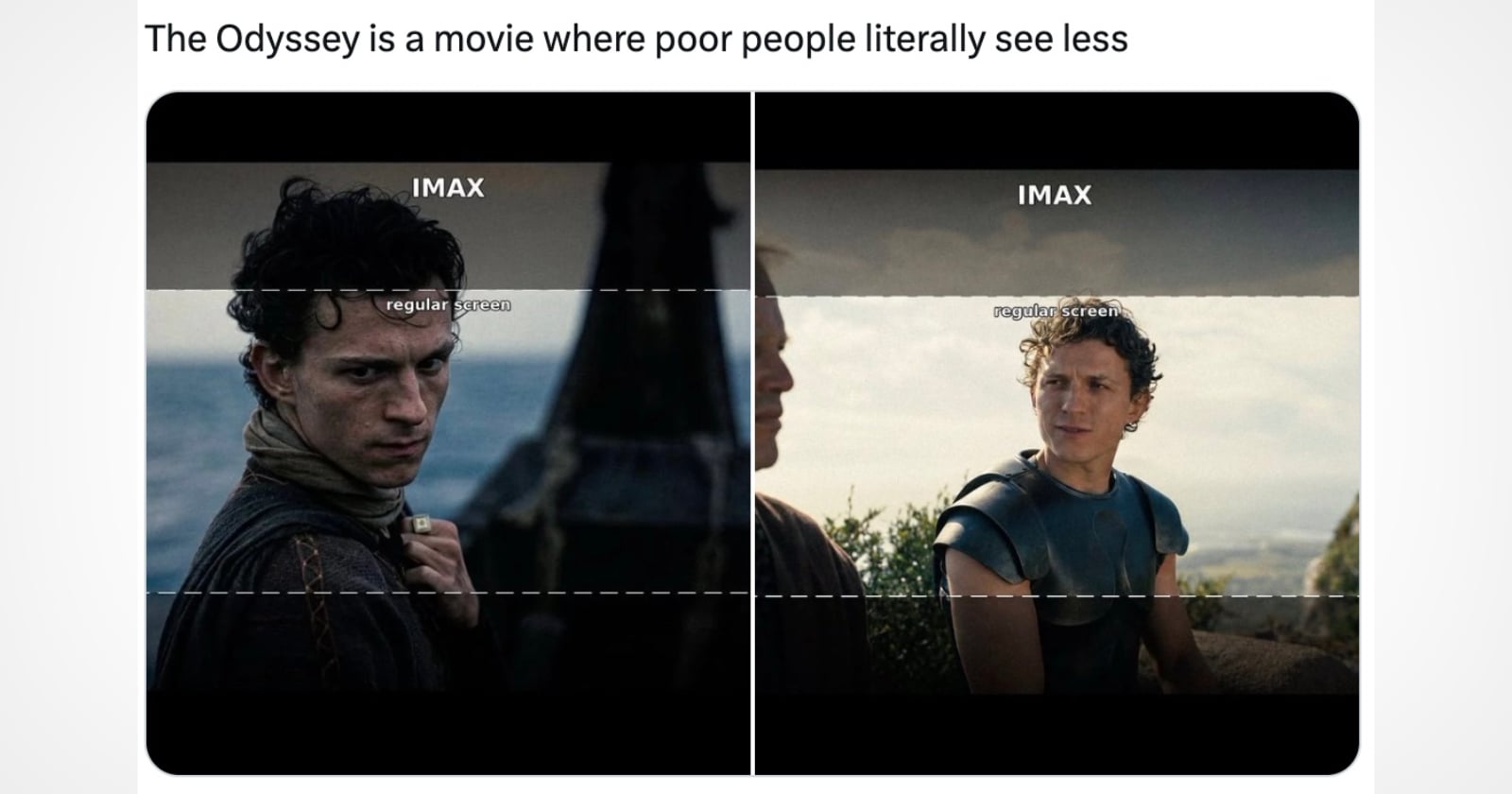
There is something quietly radical about a filmmaker insisting that scale is part of the story. Christopher Nolan's *The Odyssey* has walked into a generational storm, with Gen Z critics arguing that its IMAX 70mm screenings create an elitist divide: those who can access the full, luminous frame see more, while everyone else gets a version with fewer visible details. The meme that captured this, the one comparing the two screens side by side, lands with a specific kind of sting because it is true. A photograph loses its soul when the edges are cut. A landscape loses its grandeur when the sky is cropped. And a film about a hero's return can feel less like an invitation and more like a velvet rope when the best version of it is reserved for a handful of theaters in select cities.
But let us be careful about what we are mourning. The complaint is not that art exists in tiers; it is that access has become a status symbol. This is not a new tension, and it is worth remembering that the camera has always been a tool of both inclusion and exclusion. Consider the recent story of a photographer who turned a $4.6 million family trust into a cautionary tale of luxury and misplaced trust, as covered in A Photographer's Fall: Luxury, Swiftie Dreams, and a $4.6M Loss. That story is not about the price of a print; it is about the gap between the image we project and the reality we live. Similarly, the *Odyssey* backlash is not really about film grain or aspect ratios. It is about the fear that the cultural experience itself is becoming a luxury good, something you can only truly own if you can afford the premium seat. The audience is not wrong to notice. They are wrong to think the solution is to dumb the art down.
What would we tell a reader who asks, "Is this actually elitist?" We would say: only if we let the format become the point. The magic of cinema has never lived solely in the sharpness of a projected image. It lives in the shared breath of a dark room, in the collective gasp when a hero falters, in the way a story lingers long after the lights come up. That is why we keep coming back. It is also why we should resist the impulse to flatten every experience into a single, accessible default. The pursuit of authenticity in art, much like the pursuit of the perfect in-camera look, is not about exclusion. It is about intention. PolarPro's recent reimagining of radial filters, highlighted in Elevate Your Vision: PolarPro’s Radial Filters Reimagine In-Camera Color, reminds us that the choice to capture something a certain way is a form of authorship. Nolan is not hiding details from the poor; he is asking us to consider what we are willing to sacrifice for the sake of a shared vision. And sometimes, that means admitting that not every experience can be perfectly democratized.
The deeper lesson here is about how we value the work itself. When the U.S. Postal Service dedicates a stamp to Linda McCartney's photography, as noted in A Legacy of Vision: Linda McCartney’s Photography Celebrated by USPS, we are not honoring the convenience of the image. We are honoring the eye behind it. The same principle applies to *The Odyssey*. The film is not elitist because it was shot with intention. It becomes elitist the moment we decide that only the most expensive ticket counts as the real experience. That is a choice we make, not a rule we must accept. So here is the concrete point to watch: in the coming months, notice how the conversation shifts. If the discourse moves from "I can't see it perfectly" to "I'm still curious about the story," then we have won. If it stays stuck on the pixel count, we have lost the plot entirely. The frame matters, but only because the world inside it is worth fighting for.