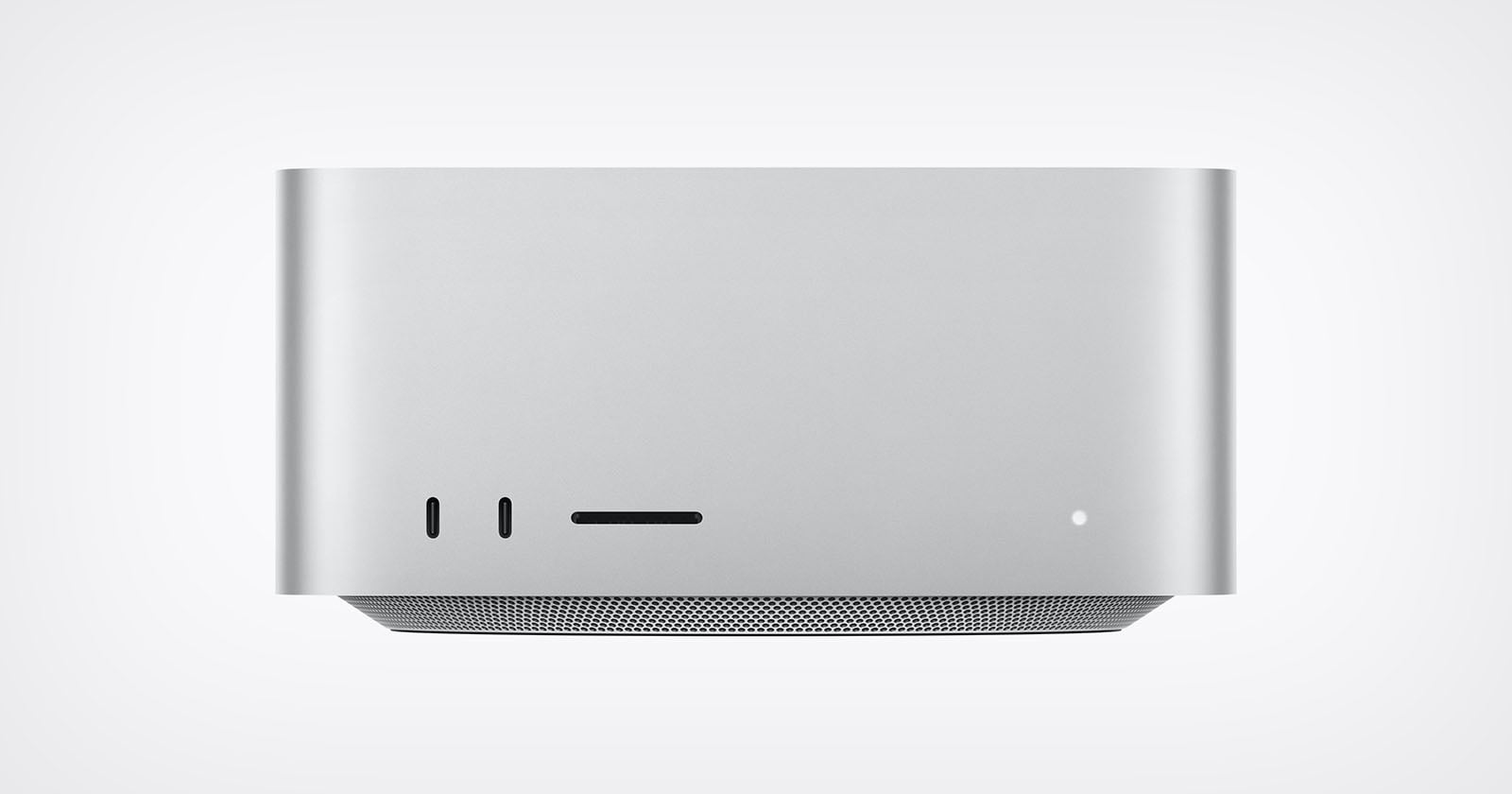
Apple's decision to drop the M5 Ultra into the Mac Studio is not just a spec bump; it is a quiet declaration that the desktop workstation is no longer a compromise. With support for up to 512GB of unified memory, this machine doesn't merely open doors, it removes the walls entirely. For our readers who live in the intersection of creative ambition and technical precision, this is the first desktop that feels genuinely future-proof without demanding you wait for software to catch up. The M5 Ultra isn't about chasing numbers on a benchmark; it's about erasing the friction between an idea and its execution.
Practically speaking, this changes the calculus for anyone who has ever stared at a spinning beach ball while rendering a 3D scene or compositing 8K footage. We've long said that the Mac Studio occupied a sweet spot for solo creators and small studios, but the memory ceiling was always the quiet bottleneck. With 512GB on tap, the conversation shifts from "can I run this?" to "how many of these projects can I keep open simultaneously?" That is a meaningful shift for editors working with massive RAW libraries, motion designers juggling multiple after-effects compositions, or AI researchers fine-tuning large models locally. For the first time, the Mac Studio feels less like a powerful computer and more like a creative partner that keeps pace with your workflow, not the other way around.
What we would tell a reader who asks if this is worth the upgrade is this: it depends entirely on how much you value time over money. The M5 Ultra is not a modest step; it is a leap that will make your current machine feel like a relic, but only if your work actually stresses it. If you are a photographer who occasionally dips into video, the base model will still serve you brilliantly. But if you're a filmmaker cutting a feature, a designer building real-time 3D worlds, or a developer training models, the memory ceiling alone justifies the investment. The beauty of the Mac Studio has always been its ability to disappear into your workflow; with this chip, it does so faster and with more headroom than ever. The question is no longer whether you need the power, but whether you can afford to ignore it.
The detail to watch, however, is not the raw speed but how Apple manages thermals and sustained performance in that compact chassis. The M5 Ultra promises desktop-class power in a box that still fits under a monitor, but we've seen chips throttle under prolonged load. If Apple has solved that engineering puzzle, this is not just the best Mac Studio ever made; it is the definitive statement that power and elegance are not mutually exclusive. For our readers, the takeaway is simple: the M5 Ultra Mac Studio is the first machine that makes the phrase "creative freedom" feel like a hardware specification. And that is a promise worth holding them to.