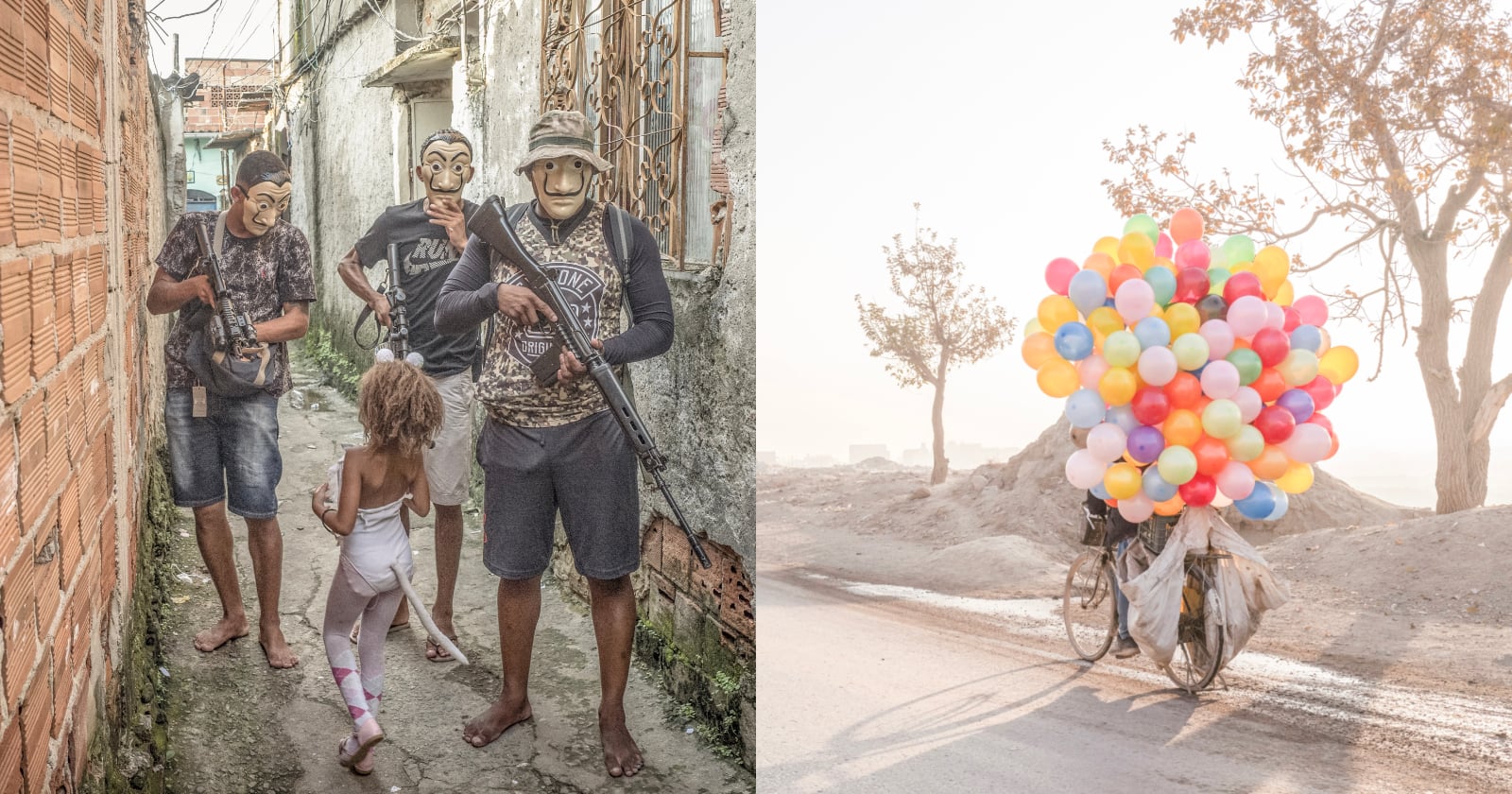
Twenty photographers looked back through years of negatives, hard drives, and contact sheets to select the two images that matter most: the one that still hurts to see, and the one that feels like a small seed of hope. The resulting exhibition, drawn from this act of archival reckoning, is not a highlight reel. It is a confession. The pairings are deliberately raw: a masked figure confronting a young girl in an alley, set against a cyclist gliding down a dusty road under a halo of colorful balloons. One frame freezes the world's weight; the other catches its lift. This is the kind of honest, unfiltered curation we champion in our own ongoing relationship with the photographic past, much like our reflection on The Curated Archive: Revisiting the Olympus E-M5, the Original Icon, where the act of revisiting older gear becomes a meditation on what endures.
There is a practical lesson here for anyone who shoots, whether you are a working professional or a weekend wanderer with a phone. We tend to organize our archives around technical milestones: the sharpest portrait, the perfect sunset, the technically flawless exposure. But the photographers in this exhibition chose memory over mastery. They selected images based on emotional velocity, not aesthetic polish. That is a braver and far more useful metric. In our own coverage of street photography, we have often noted how Finding Joy on the Streets, One Frame After Fashion reveals that the most resonant images are rarely the ones you plan. They are the ones that ambush you. So our take is simple: stop treating your archive as a graveyard of missed focus and start treating it as a diary of what you could not look away from. The blurry frame of a laughing friend might carry more truth than the tack-sharp portrait you took ten minutes later.
What strikes us most is the deliberate act of pairing. It would be easy to show the painful image alone, to wallow in the heaviness. It would be equally easy to show only the hopeful one, to offer a saccharine escape. But the exhibition's power lives in the friction between the two. The girl in the alley and the cyclist with the balloons are not opposites in a simple moral sense; they are two notes in the same chord. The pain gives the hope its texture, and the hope gives the pain its context. This is a sophisticated, artistic sensibility that speaks directly to our audience, which understands that beauty and struggle are not opposites but partners. It reminds us of the immersive, curated approach we value, where a single frame can hold a world of contradiction.
If a reader asked us what to take from this, we would say this: go back to your own archive today, not to delete, but to ask a different question. Do not ask, "Is this a good photo?" Ask, "What did this moment cost me?" and "What did it give me?" The answers will surprise you. The specific detail we are watching for is the ripple effect of this exhibition's premise. Will it inspire other photographers to do the same? Will we see more shows built on vulnerability rather than virtuosity? That is the open question. For now, we will be sorting through our own hard drives, looking for the frames that still sting, and the ones that still float. That is the real work of the medium, and it has nothing to do with megapixels.