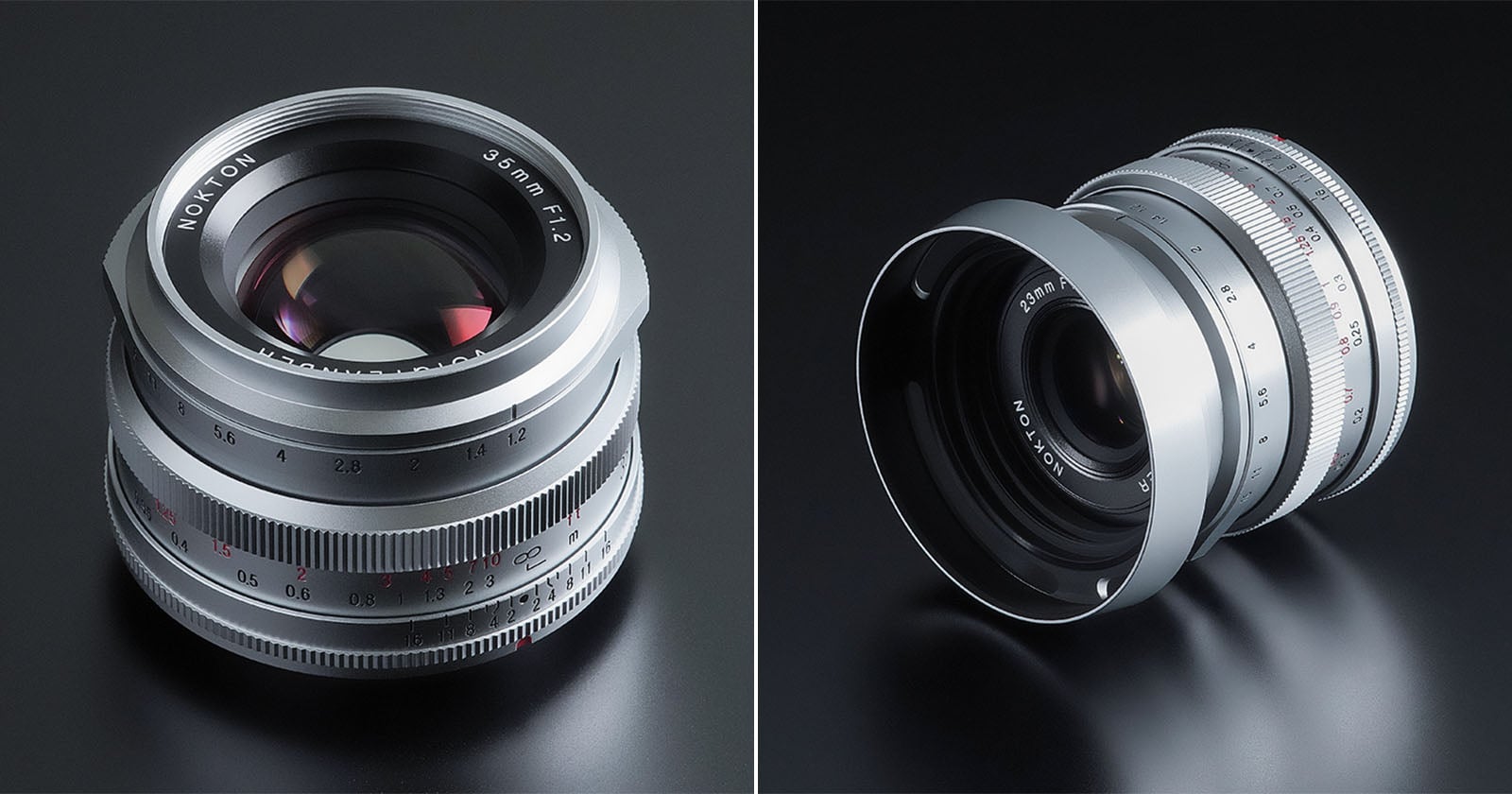
There is a quiet rebellion happening in the world of Fujifilm X Series glass, and it is dressed in polished silver. Cosina's announcement of the Voigtländer Nokton 23mm f/1.2 Aspherical and the Nokton 35mm f/1.2 for X Mount is not just a spec sheet update; it is a statement about why we pick up a camera in the first place. In an era where every new lens seems to chase clinical sharpness and weather-sealed heft, these two primes lean into something more romantic: the tactile joy of a manual focus ring and the character that comes from glass designed with intention rather than mere measurement. We are not here to tell you that autofocus is obsolete, but we are here to say that slowing down has its own rewards. This feels like a natural extension of the conversations we have been having about finding joy in the streets, where the rhythm of shooting often matters more than the gear's spec sheet. The silver finish is not just aesthetic; it is a nod to the photographers who believe that what you carry should feel as good as the images it creates.
For the working photographer, this release raises a practical question: what does a manual focus lens with a fast f/1.2 aperture actually do for your daily craft? The answer is simpler than you might think. It forces a connection. Without the safety net of autofocus, you become hyper-aware of distance, light, and the micro-movements of your subject. The 23mm and 35mm focal lengths are the classic storytelling pair, wide enough for environmental context, fast enough to isolate a face from a busy background. We would tell a reader considering these lenses to see them not as a limitation but as a creative constraint that breeds expression. This is not a tool for every high-pressure assignment, but for the slow weekend shoot or the deliberate portrait session, it is pure magic. And let's be honest, the aesthetic appeal of that silver barrel on a black Fujifilm body is a legitimate part of the appeal. It is a conversation starter, a piece of jewelry that happens to take stunning photographs.
What we find most compelling here is the counter-programming. While the industry pushes toward computational photography and ever-increasing resolution, Voigtländer is betting on the fundamentals. This move also echoes the spirit we saw in the Experience Photography's Artistry: The 5 Boro Foto Fest Returns, where the emphasis was on the craft and the community rather than the latest technological leap. It is a reminder that photography is as much about the hand and the eye as it is about the sensor. The Nokton lenses are not for everyone, and that is precisely the point. They are for the photographer who has shot a thousand frames with autofocus and wants to remember what it feels like to be surprised. They are for the artist who understands that a slightly imperfect, characterful wide-open rendering often carries more emotion than a sterile, pixel-perfect image.
Our take is straightforward: this is a welcome addition to the X Mount ecosystem, but it is not a call to abandon your current kit. It is an invitation to add a tool that prioritizes feel over convenience. The specific takeaway we would offer is this: if you have ever found yourself chimping through menus or letting the camera make the creative decisions, these lenses will snap you back to the moment. They ask you to participate. The real question is not whether you need a manual lens in 2026, but whether you are willing to let the act of focusing become part of your voice again. Watch for the reviews on the bokeh wide open and the feel of the dampened focus ring, because those details will define whether this is a novelty or a new favorite. For now, we are simply glad that someone is still making tools that make us want to slow down and see.