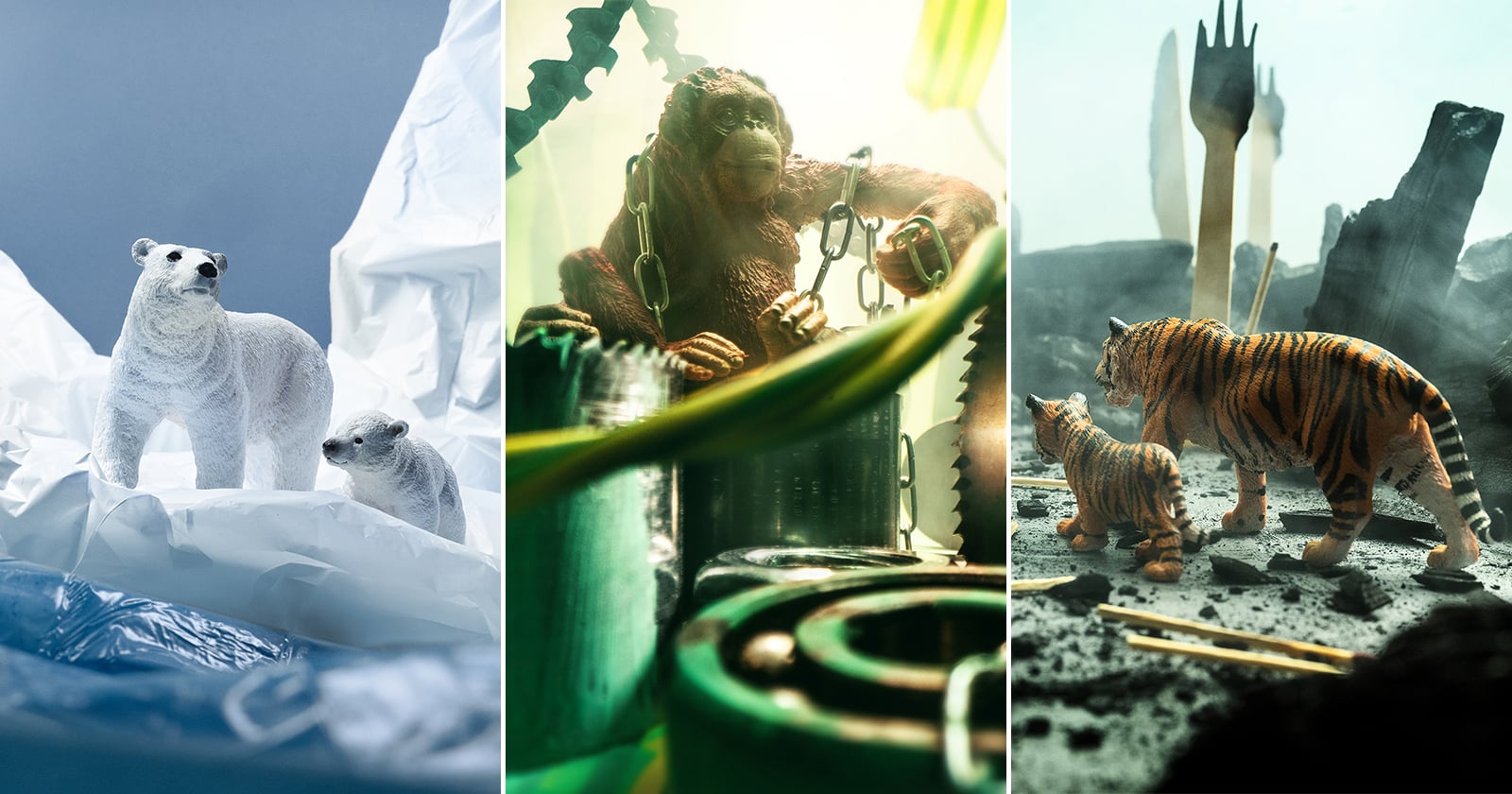
Benedek Lampert has spent years crafting tiny, meticulous worlds, scenes that fit in the palm of your hand and invite you to lean in closer. With *The Nature We Replaced*, he has turned that miniature gaze toward something far more urgent. The new series places toy animals, polar bears on plastic, an orangutan wrapped in chains, tigers in a wasteland, directly into the objects and materials that threaten their real counterparts. It is a simple, devastating visual equation, one that trades the whimsy we might expect from miniatures for a stark, quiet confrontation. We are not looking at a diorama of a lost world; we are looking at a blueprint for one.
This is where Lampert's work intersects with the broader conversations we have been following here, particularly in how we frame environmental stories. We recently looked at the hard data behind South Africa's cheetah population, a A Quiet Count: South Africa's Cheetah Population Reveals a Stark Reality that relies on numbers to make its case. And we have explored the simple, human joy of Finding Joy on the Streets, One Frame After Fashion, a reminder that photography can be both a love letter and a ledger. Lampert's work sits in the space between those poles. The data tells us the scale of the loss, the street photography reminds us of the beauty we are trying to preserve, and his miniature scenes make the abstract tangible. He is not showing us a cheetah in the wild; he is showing us the chain link fence that is slowly replacing it. That shift, from documentation to allegory, is what makes the series so effective.
Our take is that this is exactly the kind of artistic risk we need more of. It would be easy for this concept to feel gimmicky, a clever trick that wears thin. But by keeping the scenes sparse and the metaphor clear, Lampert avoids the trap of sentimentality. He is not asking us to cry; he is asking us to see. The plastic that strangles a polar bear in his frame is the same plastic we hold for five minutes before discarding. The chain on the orangutan is the same supply chain that delivers our palm oil. This is not a lecture; it is an invitation to connect the dots. For our readers, the practical takeaway is a lens shift. We are not just looking at a photograph; we are looking at a mirror. As a piece of art, it is a reminder that the most powerful environmental messages often come not from the grand gesture, but from the deliberate, careful observation of the small and the overlooked. It is a lesson in scale, and a profound one.
What we would tell a reader who asks about this series is to spend time with it, not just scroll past it. Let the discomfort sit. The specific detail to watch is the materiality of the objects he chooses; the gloss of the plastic, the rust on the chain. That is where the story lives. The true consequence of his work is not in the frame itself, but in the moment you set down your own plastic bottle, look at it differently, and wonder if you are holding the next exhibit.