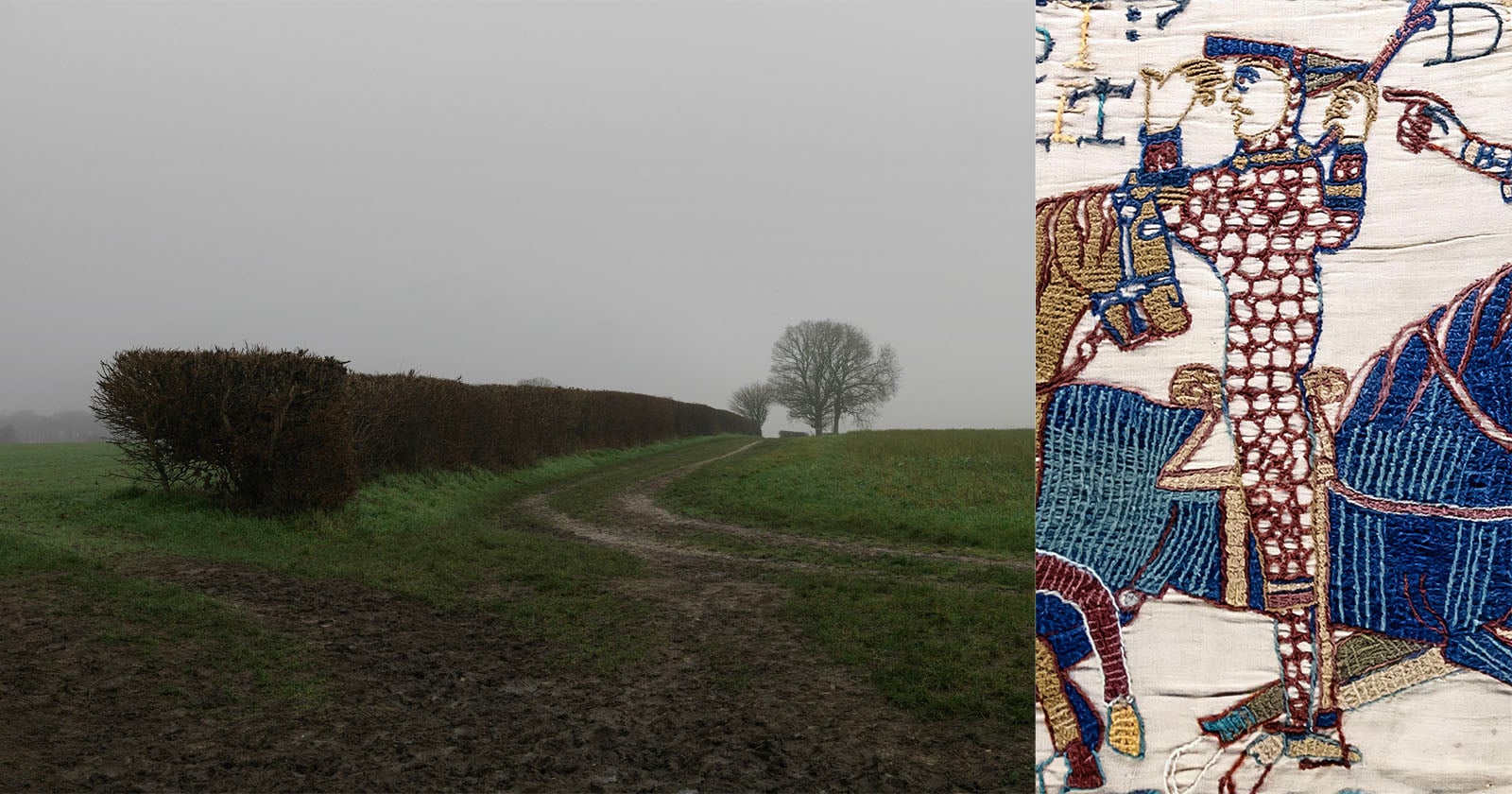
There is something quietly radical about a photographer who walks the exact path of a medieval army, not to reenact conquest, but to see what the land has kept and what it has let go. Peter Caton's project, retracing William the Conqueror's 1066 march across England, offers a lens on history that feels less like a lesson and more like an invitation to look closer. And that, we think, is exactly what great visual storytelling should do: refuse to let the past become a flat, distant image. This work resonates with the raw, personal artistry we admired in Through Jayden Tan's Lens, the Raw Artistry of Boyhood Unfolds, where the subject was not a battle but the quiet unfolding of youth. Both photographers prove that the most compelling frame is often the one that slows us down.
What Caton achieves is not a dry historical record. He layers the present over the past, letting muddy paths and foggy fields speak alongside the Bayeux Tapestry's stitched knights. The split-screen image in his work, a rural path beside a tapestry detail, captures this tension perfectly. We are seeing two Englands at once: the one that remembers and the one that simply exists. For our readers, who move between worlds of curated aesthetics and authentic experience, this is a powerful reminder that history is not locked in archives. It is still underfoot, waiting to be reframed. It is a practice we recognize in the critical eye brought to the Snapdragon Summit in The Agentic AI Shadow Cast at Snapdragon Demands a Photographer's Second Look, where technology's promises demanded a second, more skeptical frame.
The practical takeaway here is direct: the best way to understand a place is to move through it slowly, with intention, and with a camera that treats the landscape as a collaborator, not a backdrop. Caton's march forces us to consider what we miss when we rush. Every hill, every river bend, every weathered gate on his route is a fragment of a story that refuses to be simplified into a textbook paragraph. This is not nostalgia; it is a form of attention that feels increasingly rare. It echoes the deliberate, curated perspective we saw in DJI's Curated Lens Outshines Japan's Iconic Camera Giants, where the tool itself was designed to see the world in a more composed, intentional way.
What lingers after reading about Caton's journey is a specific, open question: how much of the landscape we walk through every day is still carrying the weight of a thousand-year-old march? The answer, for anyone paying attention, is more than we care to admit. And that is the detail worth watching, not the conquest, but the quiet persistence of the ground beneath our feet.