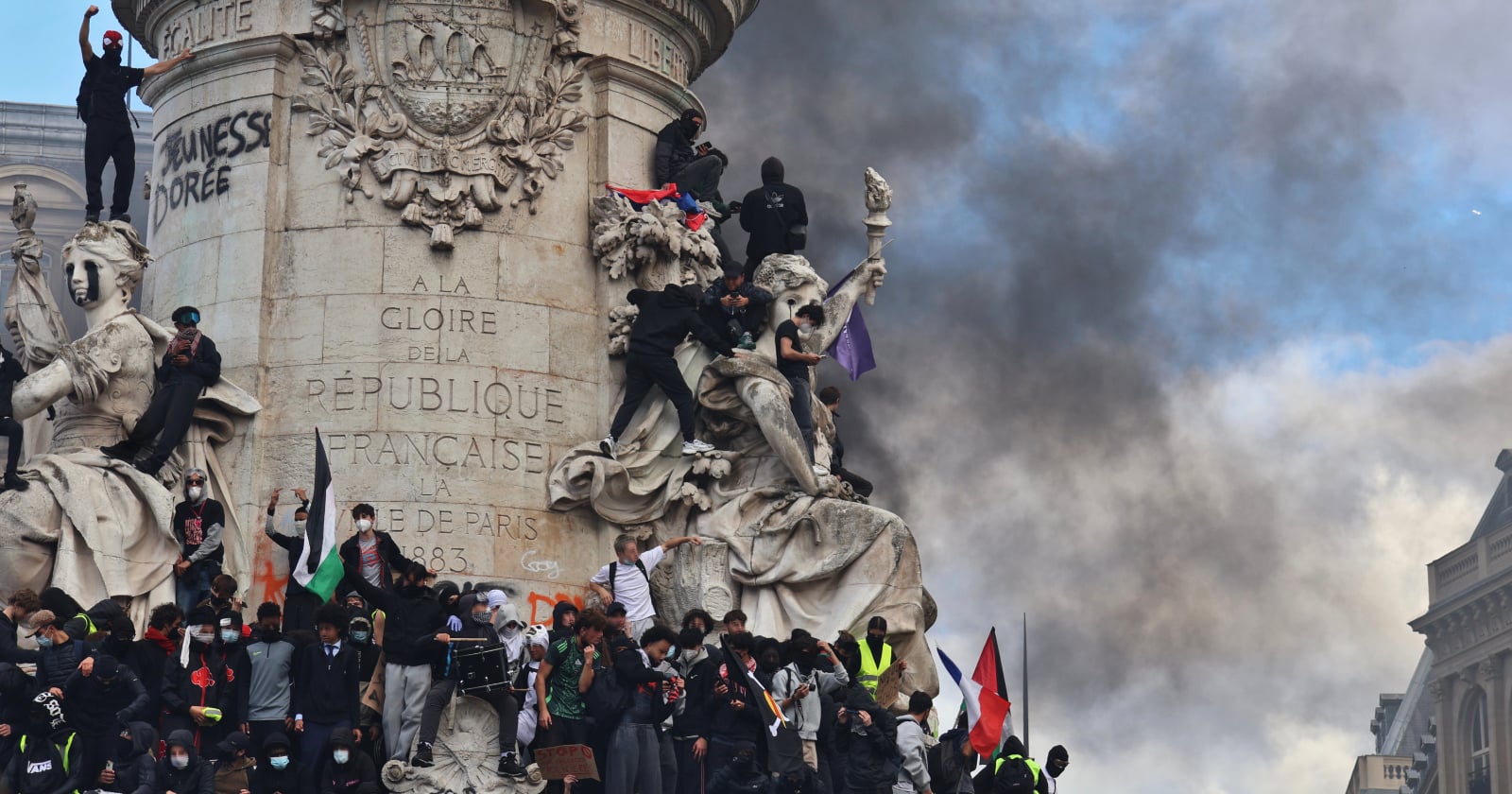
The photographer covering the Paris protests did not just risk his life to capture a frame, he almost lost it, reportedly bleeding out after a police grenade struck him. This is not a footnote to the day's news; it is a brutal reminder that the lens is never a shield, and that the people behind our most urgent images are mortal, fragile, and deeply human.
We have written before about the symbolic weight of a single photograph, how a statue based on Joe Rosenthal's *Raising the Flag on Iwo Jima* was beheaded with a sledgehammer, an act of violence against memory itself. And we have celebrated the quiet virtuosity of three top magazines, Vogue, Elle, and The Wall Street Journal Magazine, sharing a single photographer's vision, a rare convergence of craft and commerce. But this story from Paris strips away the metaphor. There is no icon here, no collaborative triumph. There is a person, a camera, and a fragment of metal turning a documentation mission into a fight for survival. The photographer's humanity bleeds through because the blood is real, and it forces us to ask: what do we ask of the people who show us what we cannot see?
For our audience, creative collaborators, health-conscious souls, seekers of the curated and the authentic, this incident should land with particular weight. We often frame photography, fashion, and fitness as worlds of aspiration: the perfect shot, the striking editorial, the sculpted body. But the Paris photographer reminds us that the most powerful images are born from exposure in every sense. He was not in a studio. He was in a crowd, doing the work of witnessing, and the price of that witness was nearly his life. It is not a new story, another photographer took a 200-foot fall in Portugal and somehow kept his spirit unbroken, but it is one we cannot afford to scroll past. It asks us to consider the ethics of consumption: when we share a protest photograph, do we pause to think about the person who took it?
The concrete takeaway is this: we should demand that publications, agencies, and newsrooms treat the safety of their visual journalists as non-negotiable, not as an afterthought covered by a waiver. Paris is not an anomaly; it is a pattern. Until the industry insists on better protection, better equipment, clearer rules of engagement, real medical support on the ground, every powerful frame we see comes with an invisible cost. And the question we must sit with is whether we are willing to pay it.