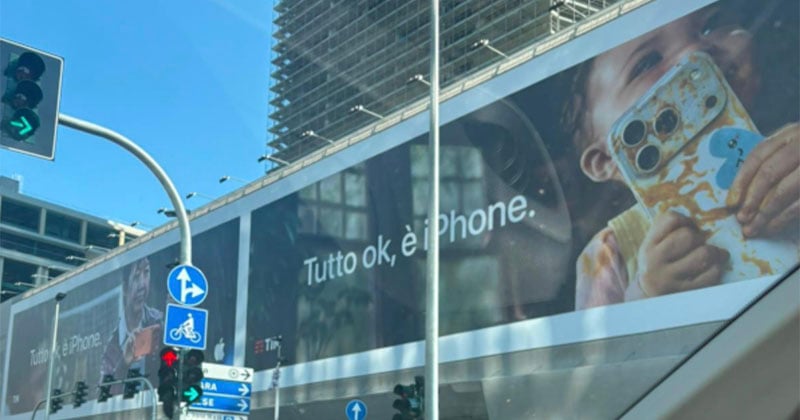
The image is arresting in its simplicity: a small child, hands wrapped around a glossy iPhone, face lit by the screen's glow, while the tagline above reads, "Tutto ok, è iPhone." In Italian, that translates to "It's all okay, it's an iPhone." Onlookers in Milan and beyond have not found it okay at all. They have filed complaints with Italy's advertising regulator, arguing the ad normalizes handing a sophisticated piece of technology to a toddler, and perhaps more pointedly, that it romanticizes a moment many parents know is far from serene.
We get the outrage, and we also get the pushback. For every critic who sees a digital pacifier, there is a parent who sees a child learning, exploring, and yes, occasionally dropping a device that somehow survives. But what makes this ad feel different from the usual tech-giant provocation is the lie of ease it tells. The child is calm, the composition is curated, the lighting is warm. There is no tantrum when the Wi-Fi drops, no tears when the screen freezes, no sticky fingers smearing the camera lens. It is the fantasy of control, not the reality of a toddler.
Here is where we find the connective tissue to the work we have been following. When Leica Elevates iPhone Photography with Curated LUX Ecosystem & McCurry Filter landed, we celebrated it for treating the iPhone as a serious tool for artistic vision, not just a convenience. And when Leica Lux 2.0: Crafting iPhone Photography with Artistic Vision followed, we noted how the company's filters and presets push users to see the world with intention, to slow down and compose. That is the opposite of what this Italian ad does. It does not ask the child to create, document, or engage. It asks the child to consume. The camera is on the child, but the child is not looking at anything except the screen. There is no curiosity in the frame, only absorption.
Our honest take is this: the ad is not dangerous because it shows a toddler with an iPhone. It is problematic because it sells a lie to adults about what that experience means. The child is a prop, not a protagonist. In that sense, the regulator's attention is warranted, not because the image will corrupt a generation, but because it erases the messy, unglamorous, and often frustrating reality of parenting in the digital age. We would tell a reader who asked us directly: do not buy the fantasy the billboard sells. The iPhone is a remarkable tool, but it is not a babysitter, a pacifier, or a substitute for a caregiver's attention. It is a tool you hand over with boundaries, and those boundaries are what the ad conveniently omits.
The practical consequence for our readers, many of whom are creative professionals and thoughtful parents, is to recognize the gap between the ad's aesthetic and their own lived experience. You can love a product without loving every story it tells. And if you are looking for a story that rings true, consider the Premiere Arrives on Android: Elevate Your Mobile Video Editing piece we ran, which framed mobile creativity as an act of deliberate choice. That is the better narrative: not a passive child absorbing light, but an active mind shaping something from it. The ad may pass review, but it cannot be regulated into authenticity. What we choose to show our children, and what we choose to let them see us do with a device, will always be the more telling frame.