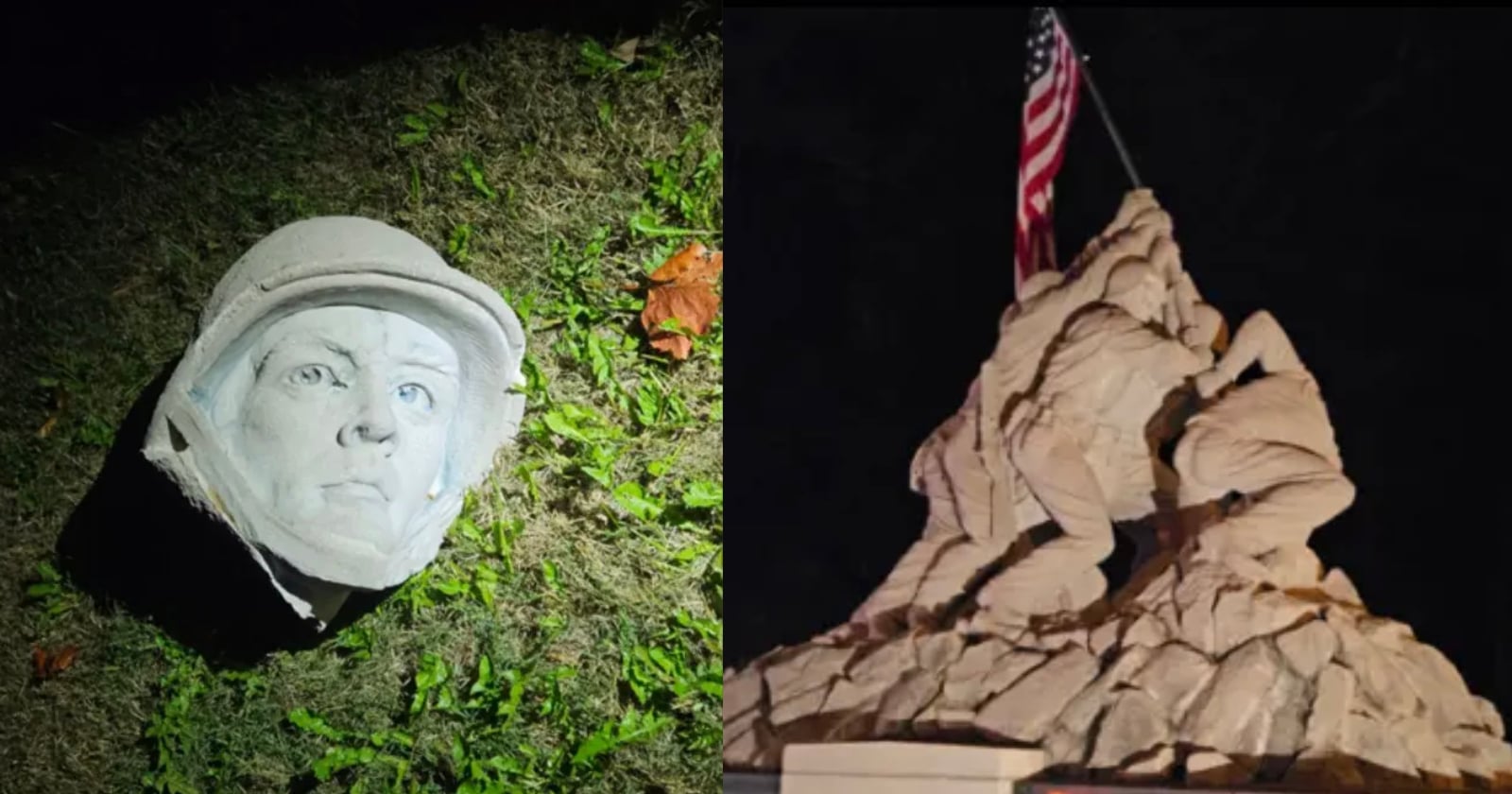
An icon of collective sacrifice has been reduced to rubble by a single, violent act. The bronze statue based on Joe Rosenthal's *Raising the Flag on Iwo Jima*, itself a masterclass in captured emotion, was beheaded with a sledgehammer, incurring hundreds of thousands of dollars in damage. This was not merely vandalism of metal and stone; it was a deliberate strike against a narrative of unity, and one that forces us to ask what, or who, we are truly protecting when we claim to defend a symbol.
We make art out of war because we need a handle on the chaos. That photograph, taken in 1945, distilled a moment of improbable triumph into an image that became shorthand for courage. A statue built from that frame carries the same weight: it is a piece of public memory made permanent. To see it shattered is to witness a kind of historical amputation. This act echoes a larger cultural tension our readers navigate daily, the friction between the curated and the raw. In our piece When Three Top Magazines Share a Single Lens, we explored how three major publications chose the same photographer for their November issues, raising questions about homogeneity in visual storytelling. Here, the opposite is at play: one image, singular and storied, is destroyed in a bid to remove its voice entirely. Meanwhile, in A 200-Foot Fall in Portugal, Then a Photographer’s Unbroken Spirit, we saw how a creator picks up the camera after catastrophe. That resilience is the counterpoint to this wreckage, a reminder that the impulse to create can persist even when the object itself is broken.
For our audience of creators and health-conscious enthusiasts, this incident carries a practical lesson in curation. Whether you design a fitness space, select a wardrobe, or photograph a sunrise, you are choosing what to elevate. A public statue is a form of curation on a civic scale, it says, "This moment matters." The sledgehammer is the anti-curator's tool, a refusal to let any symbol stand. But here is the specific takeaway: destruction never erases meaning; it only recontextualizes it. The shards of that statue now carry a different story than the intact bronze did, and that story is one of fracture, not victory.
We rarely tell our readers to look closely at what is missing, but we do now. In the coming months, watch how the community around that statue responds. Will they restore it, replace it, or leave the scar as a new kind of monument? The answer will say more about our collective values than the original casting ever did.