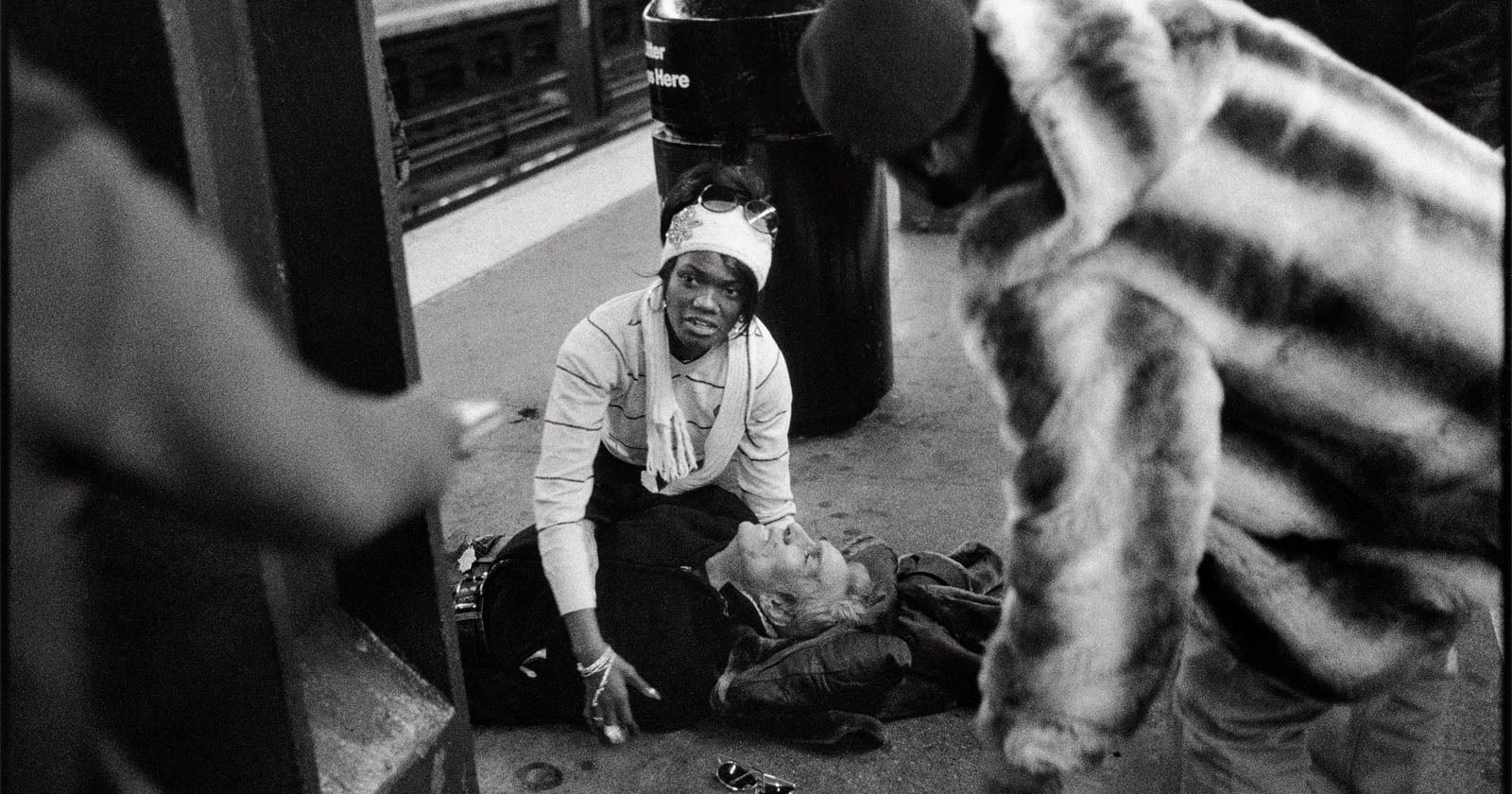
Twenty-five years of New Yorkers helping one another, captured in quiet, unglamorous frames, is not a story about nostalgia. It is a story about the architecture of daily life, the small civic muscle that flexes when no one is watching. William Meyers' new book, *Civics*, compiles this visual record into a sweeping argument: democracy is not a debate club or a ballot box, it is a woman kneeling on a subway platform to tend to a stranger. That image, a woman in a white headband crouched over a man on the ground while a passerby in a fur coat hovers, is the whole thesis in a single frame. It is not heroic in the cinematic sense. It is heroic in the way that showing up always is.
We have long argued that the best photography is not about the grand gesture but the honest one. In The Unspoken Dialogue Between Lens and Loom in Ancient Silk, we explored how craft carries memory. Meyers is doing something adjacent, but with a more urgent clock: he is documenting the quiet acts that keep a city human before they vanish into the noise of the news cycle. And in Finding Joy on the Streets, One Frame After Fashion, we celebrated the street photographer who finds poetry in the ordinary. Meyers is a cousin to that impulse, but where fashion frames a moment for its aesthetic, Meyers frames it for its moral content. He is not looking for beauty. He is looking for evidence that people keep showing up for each other, and that is its own kind of beauty.
What strikes us most is the patience. A quarter-century is not a project; it is a practice. This is not a photographer who parachuted in for a story. This is someone who understood that community spirit is not an event but a rhythm, and he learned to move with it. For our readers, the takeaway is practical: look for the helpers not as a headline but as a habit. We would tell anyone who asks that this book is not a eulogy for a lost New York. It is a mirror. It asks us whether we are building the same quiet record with our own lives. The camera is just a witness; the real work is the kneeling, the reaching out, the not looking away.
The question we are left with is not whether Meyers has documented something true, but whether we will recognize ourselves in his frames. He has given us a gift, but it is a demanding one. The concrete thing to watch is the next time you are on a platform, a street corner, a line at the bodega. Are you in the foreground of that frame, or are you just the background? Because the record is still being made, and we are all holding the shutter.