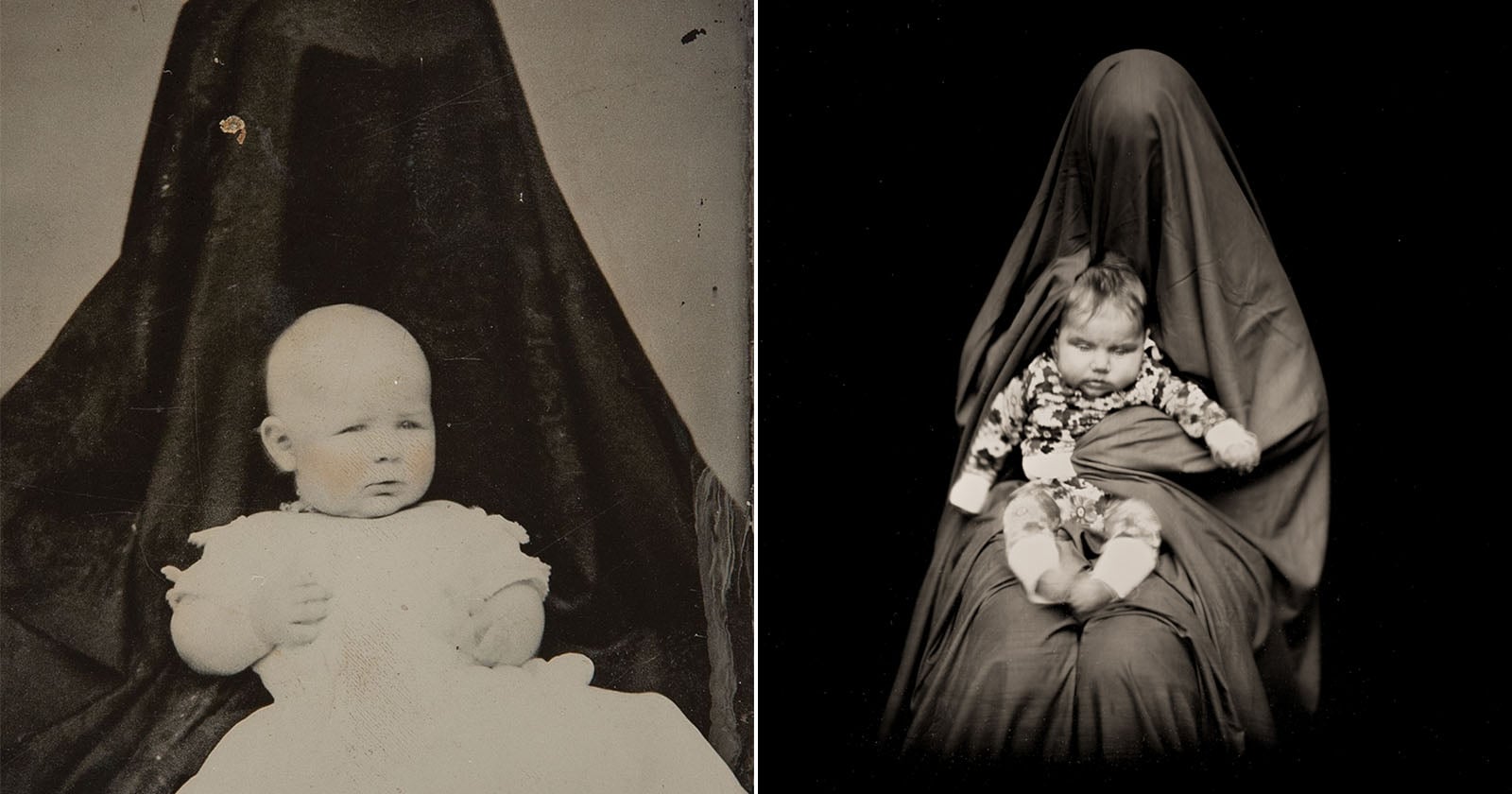
The most intimate presence in early photography was often the one you were not meant to see. For decades, the "Hidden Mother" genre, dating back to 1839 and the daguerreotype, quietly documented mothers draped in shrouds, concealed behind draped chairs, or tucked just out of frame while their infants held still for the long exposure. It is a strange and tender contradiction: a woman erased from the composition so her child could appear alone, yet she remains the invisible axis around which the entire image turns. We find this deeply moving, not as a historical curiosity but as an invitation to reconsider what we choose to hide and what we choose to reveal in our own curated lives.
This practice resonates powerfully alongside Fifty Years of Light: Portraits Frame Our Shifting National Mirror, which explores how portraiture reflects evolving ideals of identity and belonging. Where the Smithsonian's collection traces the public face of a nation, the hidden mother photographs capture the private, unseen labor behind that face. They remind us that authenticity, one of our core values, cannot always be posed. The mother's absence is not erasure but a form of devotion, a deliberate choice to let the subject speak. For our readers who navigate the intersection of artistry and daily life, there is a quiet lesson here: the most authentic image is not always the one where everything is visible. Sometimes it is the one that whispers what exists beyond the frame.
The technical necessity behind these images is equally compelling. Long exposures demanded that infants be held still, and mothers became living tripods, sacrificing their own presence for the sake of clarity. This is not unlike the discipline of the photographer who spends Twenty autumns of finding color, composition, and a richer creative rhythm learning to plan better outings and find stronger compositions. In both cases, the final image depends on invisible, repetitive effort. The hidden mother did not seek recognition; she sought stability. That quiet, unsung rigor feels especially relevant to a health-conscious, creative audience. The best workouts are not the ones we post, they are the ones we do when nobody is watching. The most elegant outfit is not the one photographed for a campaign, it is the one that makes us feel complete.
Our take is straightforward: this is not a footnote in photographic history but a mirror held up to our own habits of curation. Every time we crop a photo, filter a story, or arrange a flat lay, we are making a choice about what belongs in the frame and what is better left outside it. The hidden mother offers a direct challenge to our age of oversharing: what would we gain by stepping back, by allowing the subject, whether a child, a place, or a moment, to breathe without us anchoring the composition? The specific takeaway for our readers is this: when you next compose an image, ask yourself what you might remove rather than what you might add. The answer may be the most authentic detail of all.