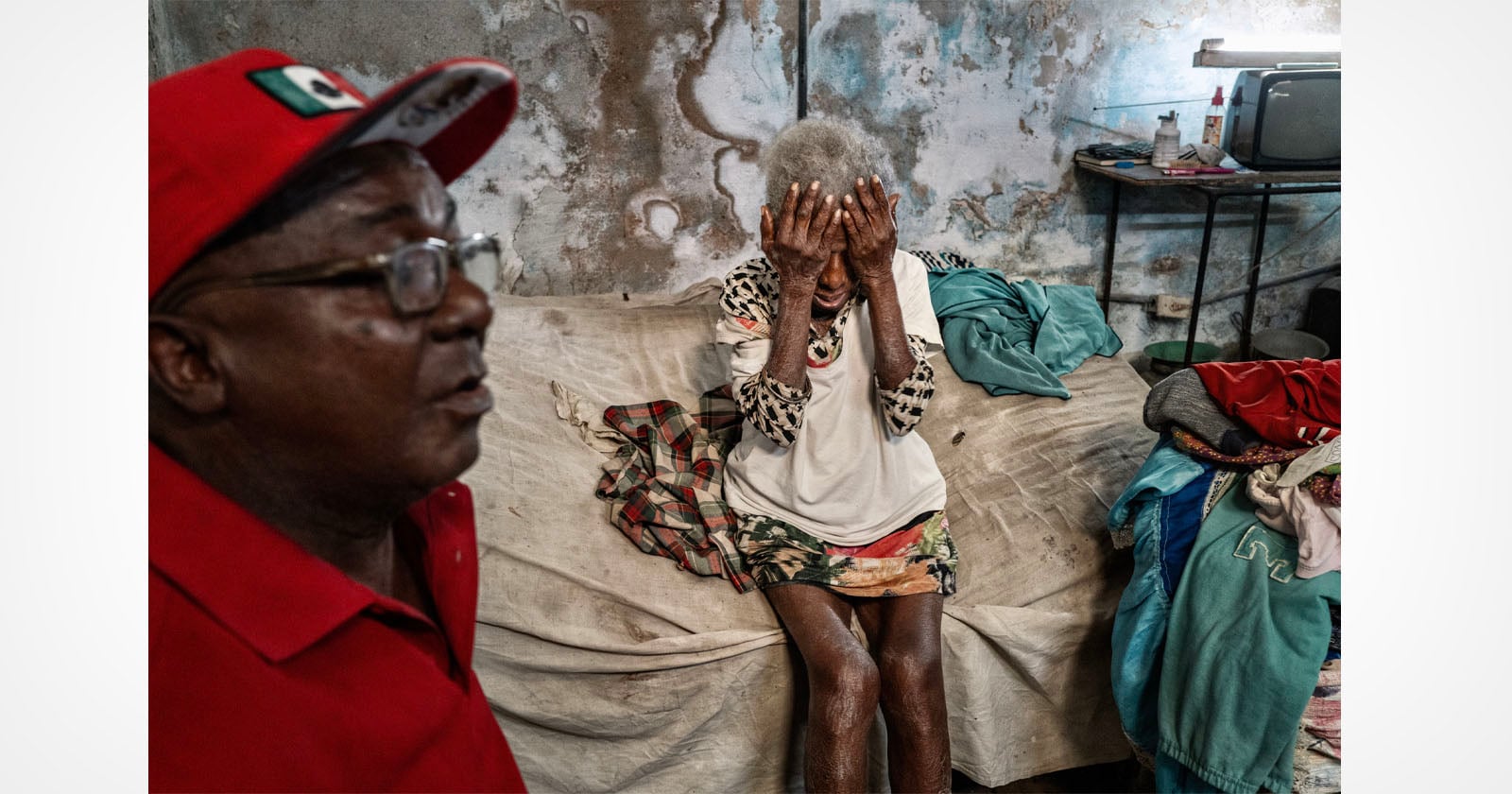
There is a particular quietness that arrives when a crisis becomes so constant it ceases to be news. Kelly Conlin's photographs from inside Cuban homes capture that quietness, and it is anything but empty. Over multiple visits to a country in the midst of a deep crisis, Conlin has found tenderness where the headlines rarely look: behind closed doors, in the soft light of a bedroom, in the gesture of an elderly woman covering her face with her hands while a man in a red cap stands in the foreground. The chaos outside is implied, but it is never the subject. The subject is the life that continues, intimate and unguarded. This is the kind of work that reminds us why photography matters, not to document what everyone already knows, but to show what we have been missing. It is a quiet act of resistance, and it feels deeply authentic.
For our readers, who move between the worlds of art and wellness, fashion and function, Conlin's approach offers a practical lesson in attention. We are trained to look for the curated, the vibrant, the aspirational. But sometimes the most immersive experience is the one that asks us to slow down and look inward. Conlin's series does not try to solve Cuba's crisis or explain it. It simply witnesses the tenderness that survives within it. This is not a story about suffering; it is a story about the texture of daily life when the world outside is unstable. It is a reminder that beauty does not require perfection, it requires presence. That is a takeaway worth quoting: *the most powerful images are not the ones that show us what is happening, but the ones that show us what is still happening beneath the surface.*
We often talk about the importance of a curated visual journey, and Conlin's work is a masterclass in that discipline. It stands in contrast to the polished, lens-inspired design we recently explored in Honor's latest lens-inspired smartphone frames creativity through cinematic design, where technology frames creativity through precision and engineering. Conlin's images use no such filter. They rely on patience, empathy, and an unflinching eye. Similarly, while Curated Camera Kits to Begin or Elevate Your Visual Journey can equip a photographer with the right tools, Conlin proves that the real instrument is the photographer's willingness to return, again and again, to a place that is not easy. Her multiple visits to Cuba are not a detail, they are the method. Tenderness cannot be captured on a first trip. It must be earned.
What lingers is a specific detail: the elderly woman with her hands over her face. She is not performing for the camera. She is in the middle of something private, something we are lucky to witness. That image will stay with anyone who sees it. The open question for us, as an audience that values both aesthetics and meaning, is whether we are willing to look for that same tenderness in our own lives. Conlin found it in a country in crisis. It is worth asking what we might find if we turned our gaze inward, away from the curated surface, and simply waited.