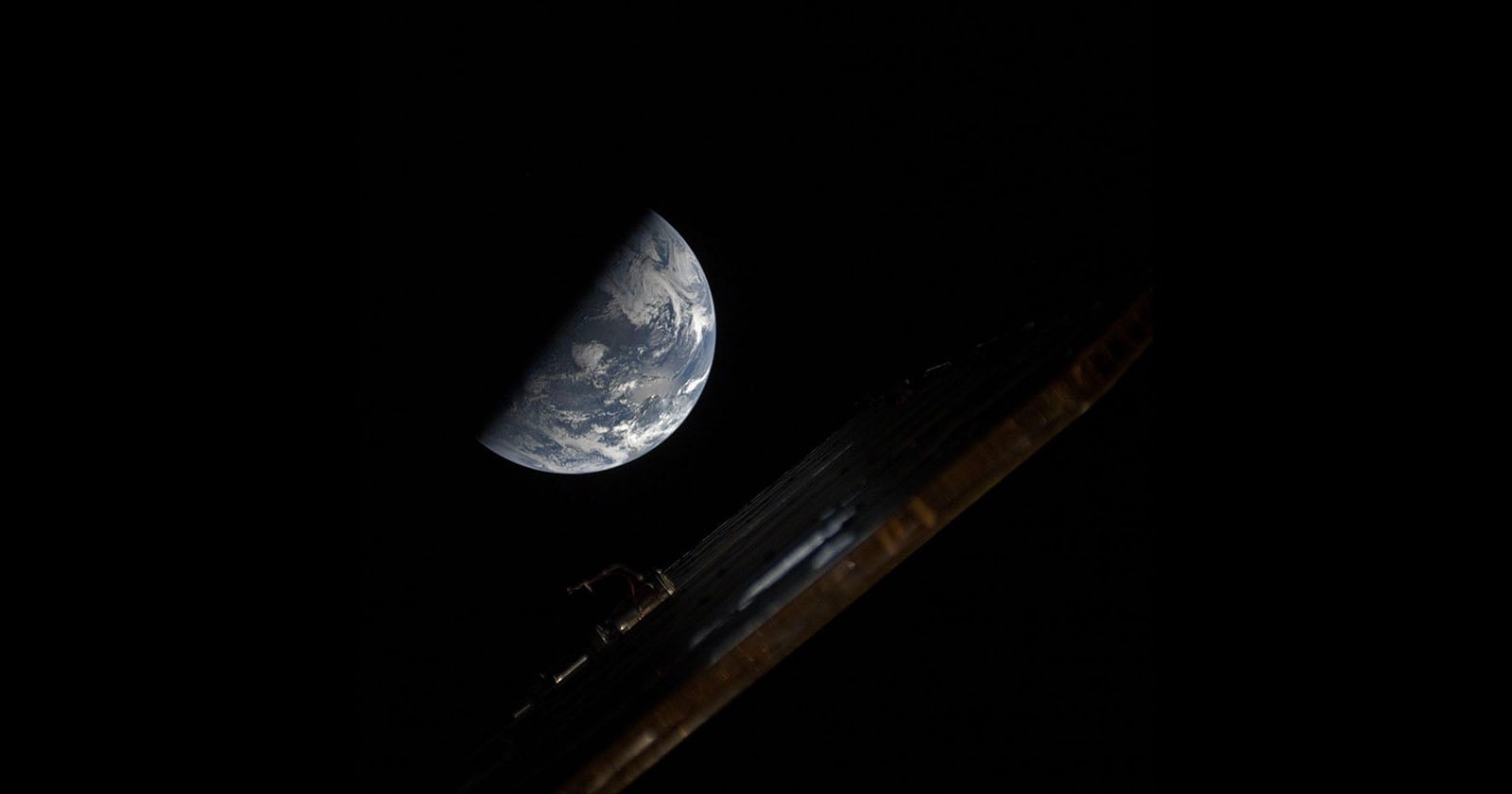
There is something profoundly intimate about a photograph taken from a spacecraft that has just used Earth as a slingshot. NASA's ESCAPADE probe, now hurtling toward Mars, turned its lens back toward home and captured our planet as a pale, delicate crescent suspended in black. It is a parting glance, and it reminds us that the most compelling images are often the ones that reframe what we thought we already knew.
We have seen Earth from space countless times, the famous Blue Marble, the pale blue dot. But this photograph feels different because it was taken by a traveler, not a resident. The spacecraft was already leaving, already committed to a trajectory that would carry it millions of miles away. That perspective matters. It strips away the noise of daily life and leaves us with a single, undeniable truth: this is the only place we have. It is a humbling image, and one that should resonate deeply with an audience that values authenticity and the intersection of art and science. It is no accident that our publication has also covered the strange beauty of Microgravity's Hidden Canvas: The Art of Cancer Cells in Space and the meticulous design of Coman's T1 Mini Tripod Nears $400K in a Crowdfunded Celebration of Design. Each of these stories, in its own way, asks us to look closer, at the microscopic, the engineered, and now the cosmic.
What makes this image so striking is not its technical achievement, but its emotional precision. The Earth is not shown in full, vibrant glory. It is a sliver of light, a crescent of atmosphere and ocean, half in shadow. That shadow is where we live. It is where every human story, every workout, every curated morning routine, every creative collaboration unfolds. The spacecraft did not linger. It captured the moment and kept moving. There is an honesty in that, an acknowledgment that beauty does not require perfection, and that departure can be as meaningful as arrival.
For our readers, the takeaway is straightforward: perspective is a creative tool, not just a metaphor. Whether you are framing a photograph, designing a space, or planning a morning, the angle from which you view your subject changes everything. The ESCAPADE image is a masterclass in that principle. It does not try to sell us on the grandeur of space exploration. It simply shows us where we are, from a vantage point we cannot reach ourselves. That is the kind of authenticity that cuts through the noise. It is the same reason we are drawn to stories like A Virtual Snapshot Earns a Real-World PlayStation Ban, because even in virtual worlds, a single image can change the rules of engagement.
So what do we do with a photograph like this? We let it settle. We resist the urge to turn it into a slogan or a brand campaign. Instead, we sit with the quiet fact that we are, all of us, on a planet that a spacecraft just left behind. The question worth asking is not whether we will reach Mars, but whether we can carry that perspective with us as we go about our day. The image is already fading from the news cycle. The spacecraft is already farther away. But the crescent remains, and it asks nothing of us except that we look.