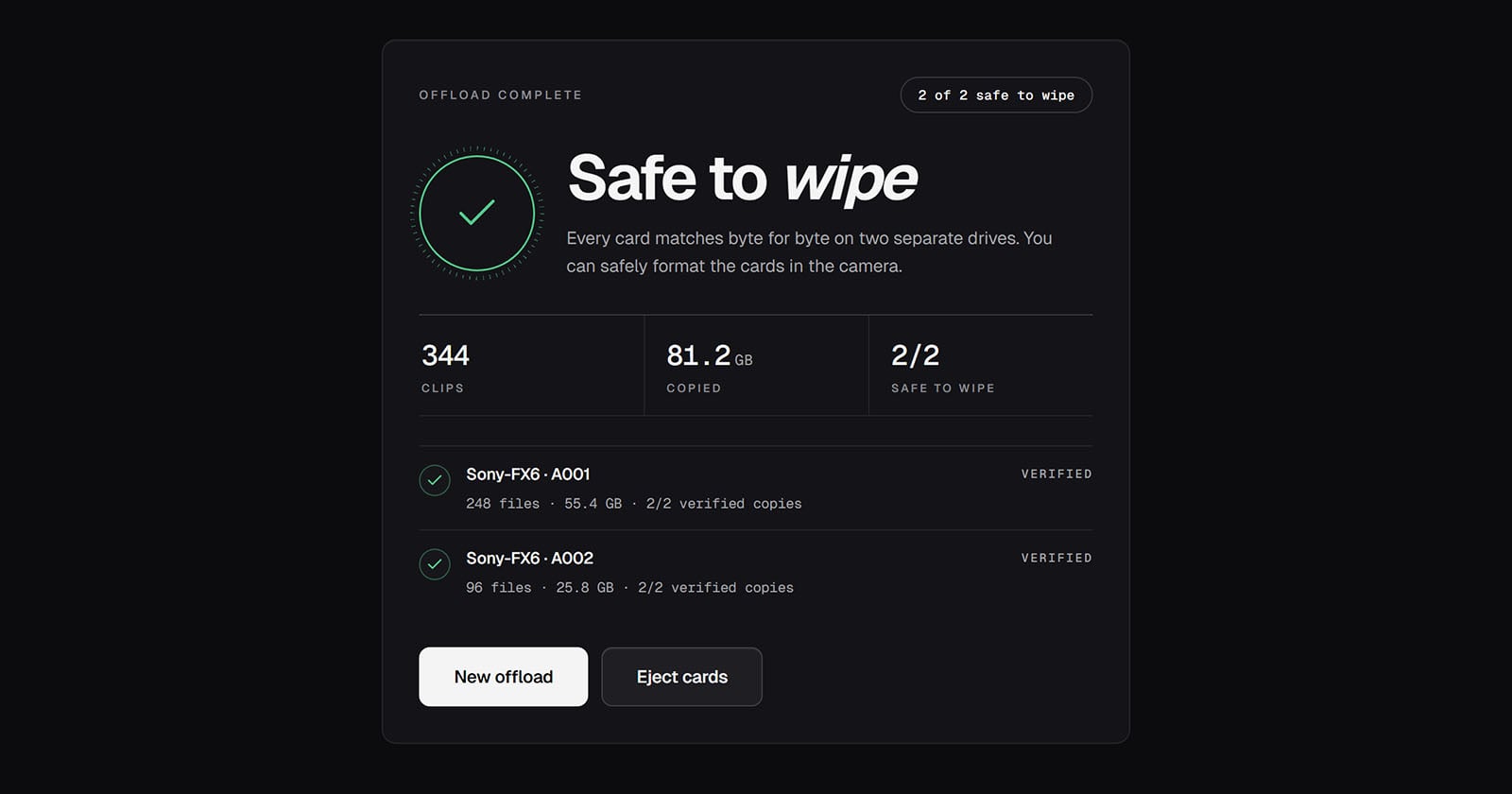
There is a particular kind of peace that settles in when you know your work is safe. It is not the thrill of the capture, nor the satisfaction of a perfect edit, but something quieter and far more precious: the certainty that the hours of footage on that fragile little card have not vanished into the digital ether. For anyone who has felt their stomach drop while staring at an unresponsive memory card, that feeling is the entire game. So when we heard about Stow, a new app built by a working videographer to answer one deceptively simple question, "Is this card actually safe to wipe?" we felt a wave of recognition. It is a tool born from a very specific, very real anxiety, and its beauty lies in its elegant restraint.
We live in an era where our tools often try to do everything at once, layering on features until the core purpose is buried under a mountain of menus. Stow takes the opposite approach, focusing on a single, crucial workflow step. It verifies that your footage has been copied correctly before you format the card, presenting a clear, green-lit "Safe to wipe" signal. This is not about flashy AI or complex cloud integrations. It is about trust. It is about the deep, unspoken dialogue between a creator and their medium, a conversation that is just as important as the Unspoken Dialogue Between Lens and Loom in Ancient Silk. In that ancient craft, the weaver must trust the tension of the thread; in our modern craft, we must trust the integrity of the data. Stow simply bridges that gap with a dose of practical, honest engineering.
The financial reality of our craft makes this more than just a convenience. Memory cards are not cheap, and the pressure to stretch their use across multiple shoots is real. But the cost of a single lost, irreplaceable moment is far greater than any card. This app does not just protect your data; it protects your sanity and your professional reputation. It allows you to walk off a job with the confidence that your narrative is intact, ready for the next chapter. This is a quiet rebellion against the chaos of a rushed workflow, an act of self-preservation in a world that demands we move fast. It is a sentiment that feels especially relevant when we consider cautionary tales in our own field, like the photographer who lost everything in a $4.6M scam by placing trust in the wrong hands. Stow offers a different kind of security, one that is tangible and verifiable, a small but significant way to reclaim control.
What we appreciate most is the creator-centric origin story. This is not a corporation deciding what a professional needs; it is a peer who saw a problem and solved it with a pragmatic, free solution. It speaks to a broader movement where artists are building their own tools, and it is a reminder that the most innovative solutions often come from the most authentic places. As we look toward a future increasingly shaped by AI and generative platforms, like the new creative power within Gemini, it is grounding to see a tool that is purely, fundamentally about the physical act of preservation. The question we should all ask ourselves is not whether we can afford to use a tool like Stow, but whether we can afford not to. The next time you are about to format your card, let that green check be the final word. It is the most artistic thing you can do for your future self.